

2026.5.20
Winds of Gold—A Hundred Views of Saihoji Vol. 25
Peter MacMillan / a translator, scholar, poet
In this series of essays on Saihoji the renowned translator of Japanese poetry and poet Peter MacMillan records his impressions of and reflections on his visits to the garden throughout the four seasons. We hope that through these essays you the readers and fans of Saihoji can feel as if you are also present in the magical garden even when you cannot visit us.
Abstracting the World of the Buddha—The Art of Domoto Insho I
As spring returns and new life begins to emerge, it offers a fitting moment to reflect on transformation and renewal. Yet it is not only nature that is constantly changing.
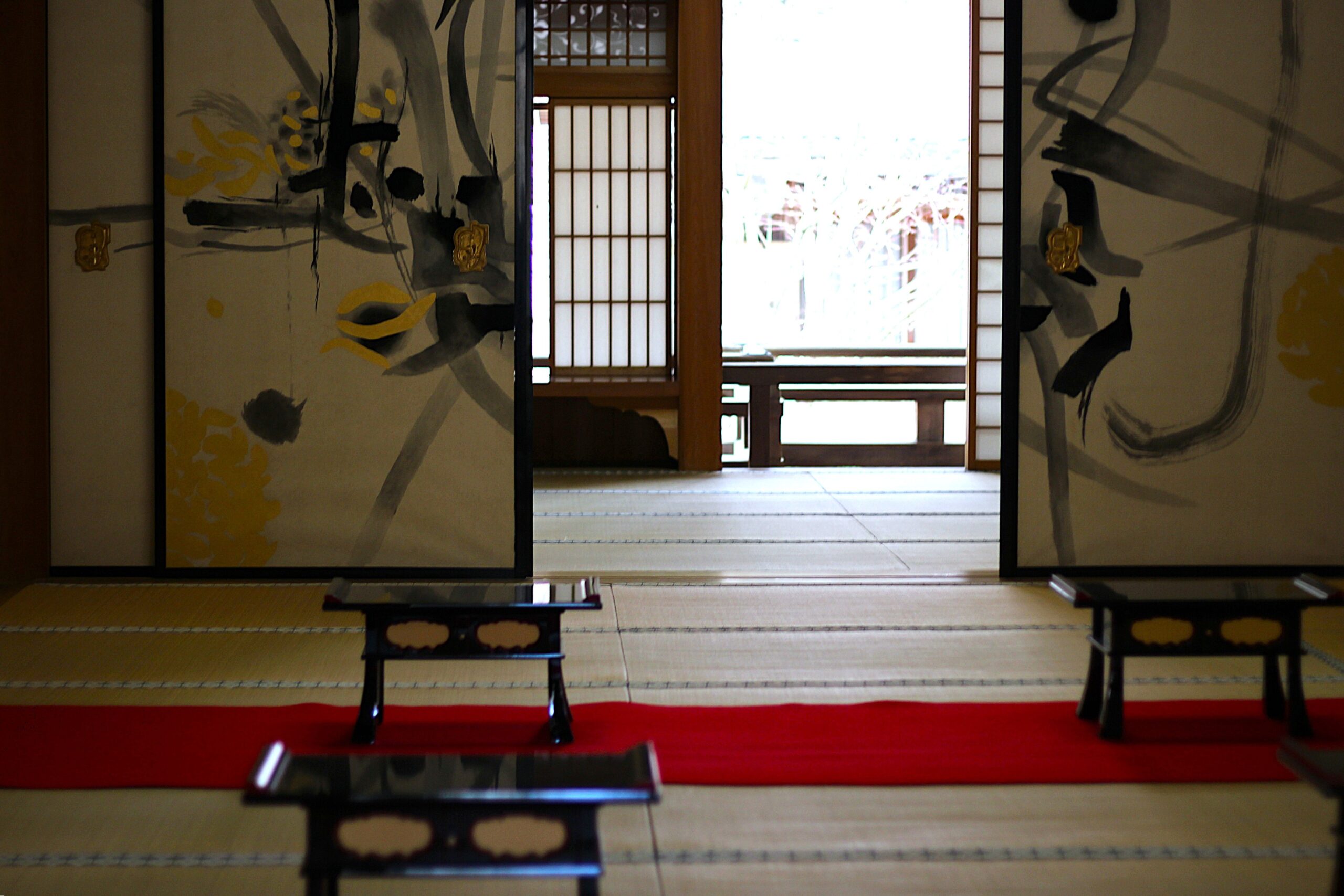
The history of Japan and its temples has also been in a state of continual transformation, gradually evolving with each era. I was reminded of this in this February on a visit to Saihoji to see the magnificent screens of Domoto Insho.
Professor Furuta gave a brilliant lecture on the artist, and my essay today is based on his fascinating talk.
The rules regarding painting motifs in Japanese art date back to the introduction of Chinese paintings to Japan and have been fixed for over a thousand years. Historically, great importance was placed on flower-and-bird paintings, ink wash works, and Buddhist images that reflected inherited aesthetic and spiritual values.
Temples especially were places where artistic expression was often guided by an established sense of “how things should be.”
However the devastation caused by World War II, which led to the loss of many cultural assets and paintings created an unexpected opening for renewal. In the postwar period, artists such as Domoto Insho emerged at the forefront of Buddhist painting, demonstrating that reverence for tradition did not require strict adherence to convention. Instead, they began to preserve what was essential while discarding rigid expectations about form and motifs.
This shift became especially visible in the fusuma paintings created from the 1950s onward at temples such as Chishaku-in. Artists such as Domoto no longer treated temple painting as a fixed continuation of past styles. Rather, they infused temple interiors with fully realized personal worldviews, making sacred spaces sites of living artistic experimentation. In doing so, they challenged the assumption that “because it is a temple, it must look this way.”
Domoto’s work especially proposed an alternative understanding—authenticity lies not in imitation, but in remaining faithful to the spiritual core while allowing form to evolve. He created a world within the confines of the temple where individuality and artistic vision were welcomed and celebrated.
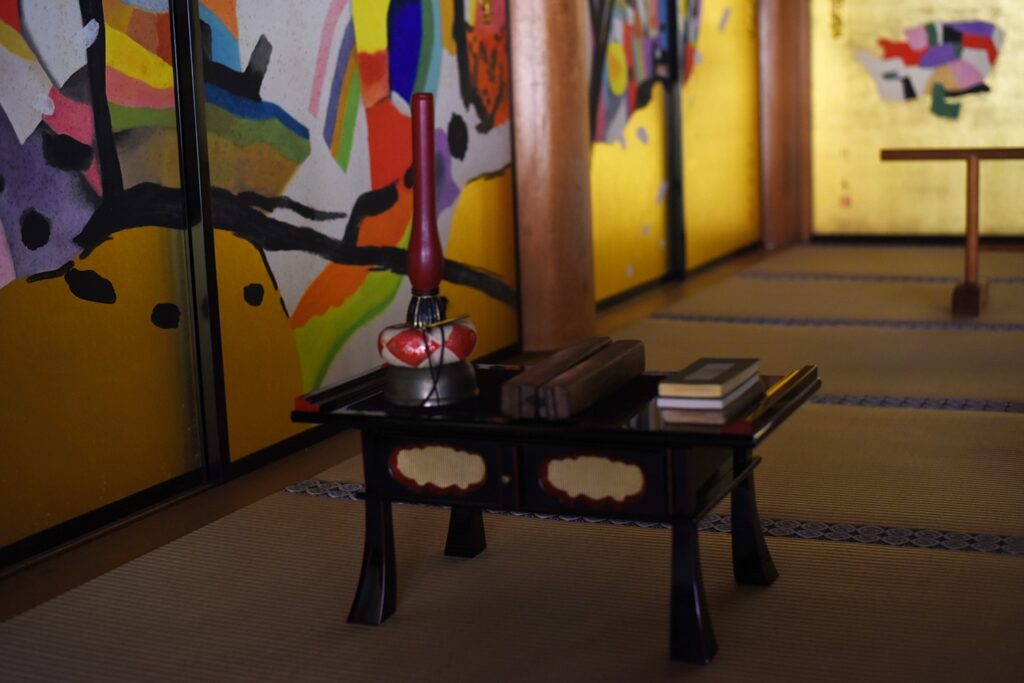
The screens at Saihoji are much easier to understand when we can see them as a remaking of an ancient tradition, preserving the original, but making radical alterations in style and image. And one does not feel in the end that the paintings have less successfully represented the world of the Buddha but rather that the abstract medium is in some ways more suited to expressing the complex cosmology and difficult to grasp aspects of Buddhism.
Moreover, the screens evoke many associations and feelings. One can sense the influence of abstract painting from Europe at the time, while also feeling that there are also depictions of almost real objects in the universe of the abstract. The screens are masterpieces of the artist showing him at the height of his powers and are extraordinarily beautiful. But the deepest feeling one gets is in the artist’s deep devotion to the world of the Buddha. His faith increases our own faith, and one leaves Saihoji feeling more at one in the universe and more conscious of our connectedness to all things.
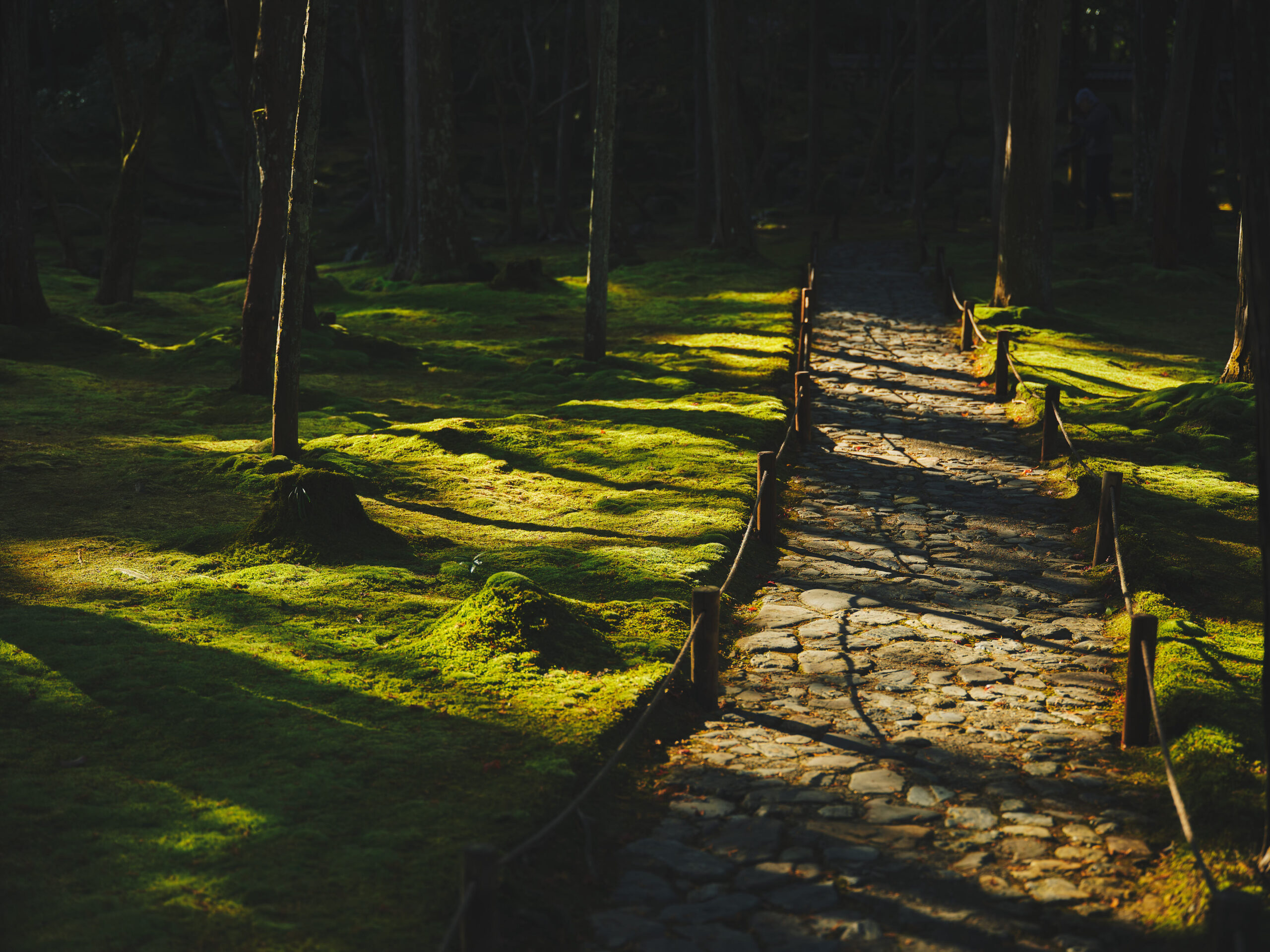
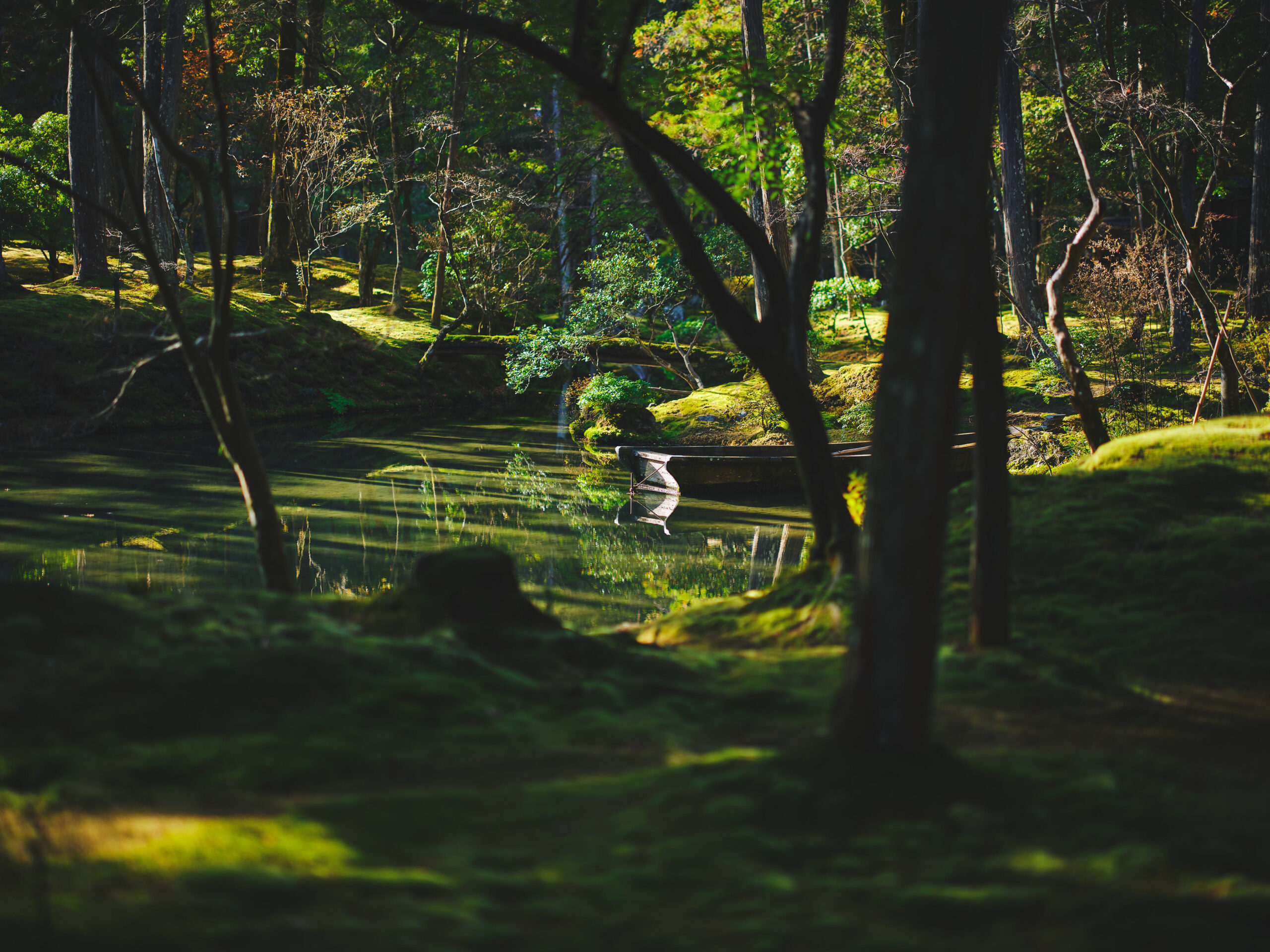
Walking around the garden after the talk I had the same feeling, expressed in the greens of the moss, the song of birds and falling blossoms of plum dancing in the wind.
In the second part, we explore the worldview that emerges as Domoto Insho's innovative fusuma paintings resonate with the natural surroundings of Saihoji.
Peter MacMillan
Peter MacMillan is a prize-winning translator, scholar, poet, and President of The Moon is a Boat Co., Ltd.
His translation, One Hundred Poets, One Poem Each (Hyakunin Isshu), was published in 2008, winning prizes in both Japan and the United States. After that, he completed an English translation of The Tales of Ise (Ise Monogatari), which was published by Penguin in 2016. He has also published a collection of poetry entitled Admiring Fields.
Awards:
Recipient of the Donald Keene Center Special Prize for the Translation of Japanese Literature
Recipient of the 44th Special Cultural Translation Prize from the Japan Society of Translators
Nominated for the PEN Award for Poetry Translation for the English translation of The Tale of Ise (Ise no Monogatari)
Up next
Most read
Your Heart
"Gratitude"
Your Heart
"What is happiness?"