
2026.4.24
Winds of Gold—A Hundred Views of Saihoji Vol. 24
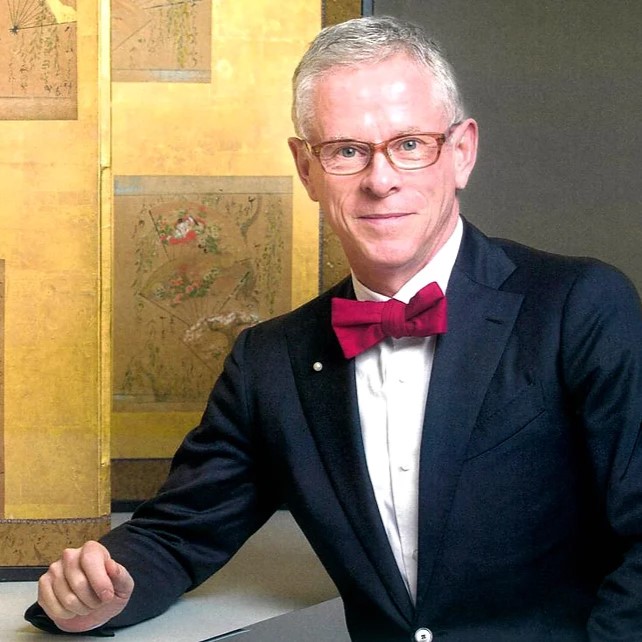
Peter MacMillan / a translator, scholar, poet
In this series of essays on Saihoji the renowned translator of Japanese poetry and poet Peter MacMillan records his impressions of and reflections on his visits to the garden throughout the four seasons. We hope that through these essays you the readers and fans of Saihoji can feel as if you are also present in the magical garden even when you cannot visit us.
The End of Your Journey
This marks the second year since the series “Winds of Gold—A Hundred Views of Saihoji” began. And I would like to think a little about the theme of Saihoji as a place of origins and journeys, as that was the sub-title I created for the Saihoji home page. When does our journey begin? I believe that is not in a road, or map, or the guidance of the stars, but rather in a longing too strong for us to contain. Just as a stone does not move unless nudged by a stream, nor do we begin without something like a ripple or even a dream. It may be a word, a wound, or a walk in the rain. It may be a faint promise of something we cannot yet explain. The origin lies not in lands far away, but from the moment we feel that we must change.
These days on each visit to Saihoji I think about the direction of the journey I am taking in my life. Sometimes on the way, I face again and again a huge emptiness in my heart, but along with my suitcases overflowing with weaknesses, there is also the expectation and a longing to discover and experience something new. Though the path around the garden of Saihoji is not an open road, whenever I go there, I always want to feel as Walt Whitman did in this poem:
“Song of the Open Road”
Afoot and light-hearted I take to the open road,
Healthy, free, the world before me,
The long brown path before me leading wherever I choose.

But what is it that we really wish to discover when we set off in on a journey on the open road? And where do we wish for the journey to lead us? I think a hint may be found in a poem by Derek Walcott:
“Love After Loved”
The time will come
when, with elation
you will greet yourself arriving
at your own door, in your own mirror
and each will smile at the other's welcome.
As the title suggests, the poem is about the joy of re-discovering yourself —both physically in your mirror but also spiritually—after you fall out of love or break up with someone and realizing that the truly important person to love is yourself. Though it is a poem about recovering from lost love, I believe it can also apply to journeys. Because the goal of all journeys is to discover or re-discover yourself and there is no more important journey than the one that helps us to acquire the ability to accept and love ourselves truly.
As in the poem, I pray that the new self that you discover on your journey will be one that you can truly love, because in the end, the compass of life is always spinning not north or south, but true—to something far, to something ancient, and to you!
Peter MacMillan
Peter MacMillan is a prize-winning translator, scholar, poet, and President of The Moon is a Boat Co., Ltd.
His translation, One Hundred Poets, One Poem Each (Hyakunin Isshu), was published in 2008, winning prizes in both Japan and the United States. After that, he completed an English translation of The Tales of Ise (Ise Monogatari), which was published by Penguin in 2016. He has also published a collection of poetry entitled Admiring Fields.
Awards:
Recipient of the Donald Keene Center Special Prize for the Translation of Japanese Literature
Recipient of the 44th Special Cultural Translation Prize from the Japan Society of Translators
Nominated for the PEN Award for Poetry Translation for the English translation of The Tale of Ise (Ise no Monogatari)
Up next
Most read
Your Heart
“The Concept of Muda”