
2026.9.5
The Genii Locorum of Saihoji
(Second Part)
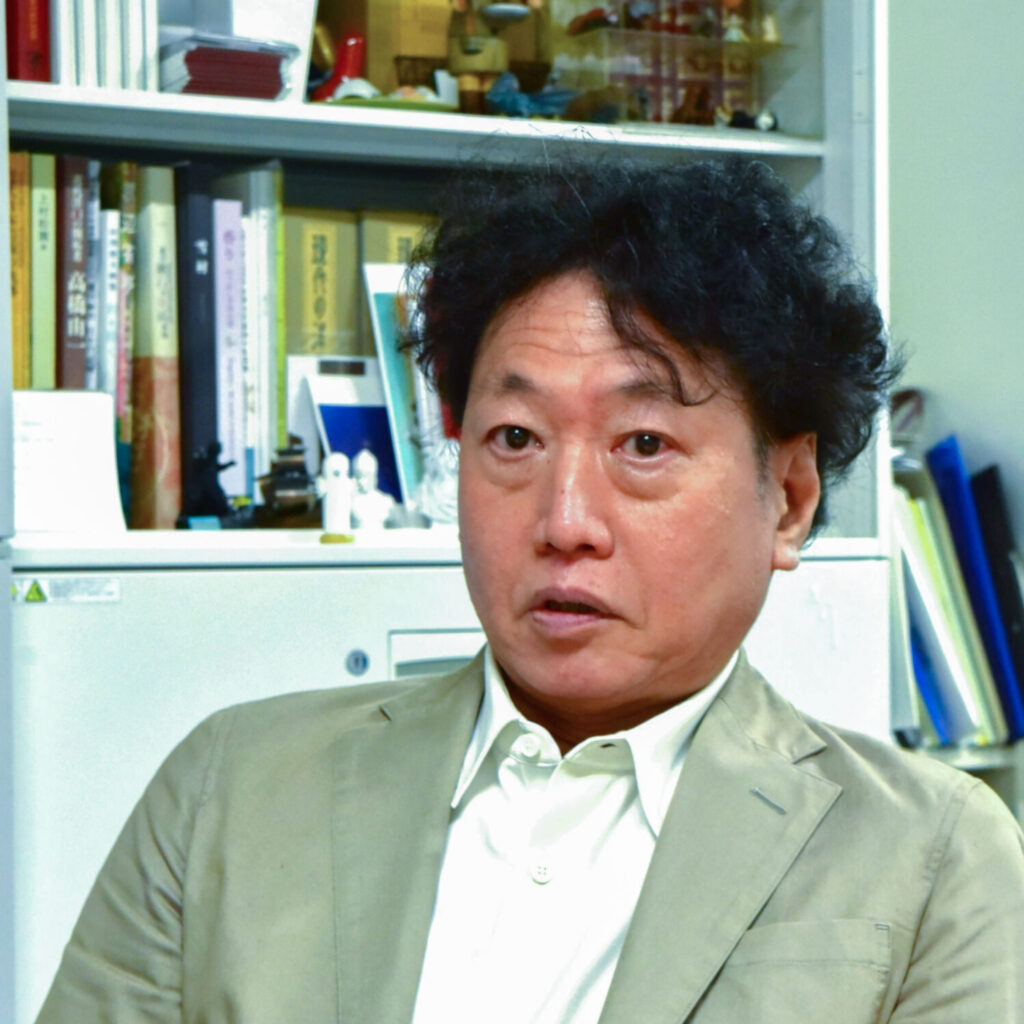
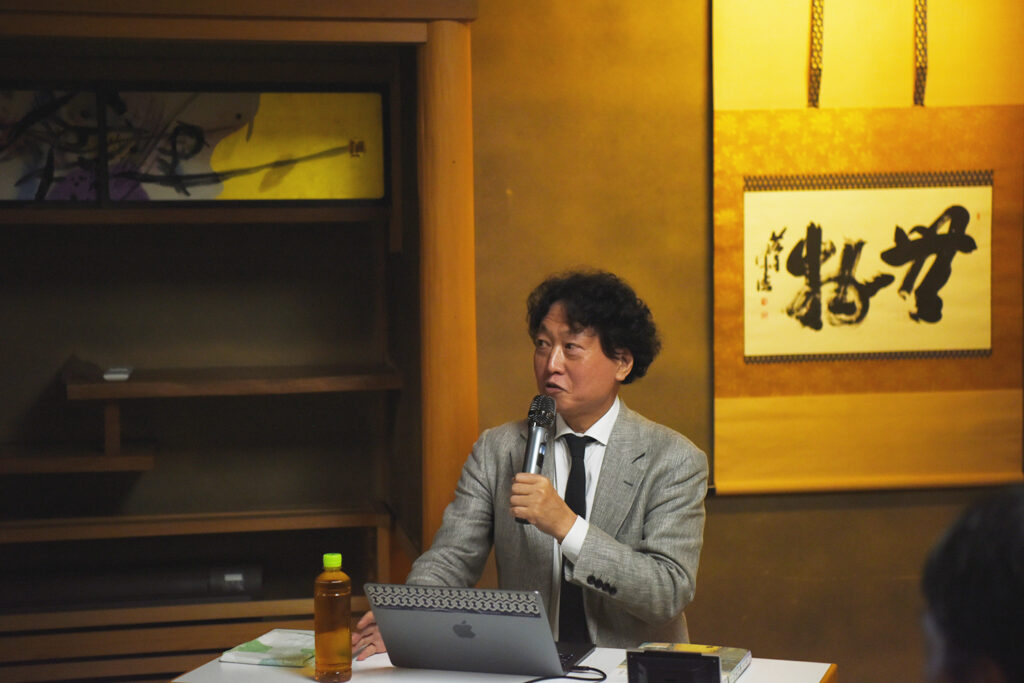
Furuta Ryo
Domoto Insho’s Abstract World at Saihoji
The ancient Romans believed that all locations were inhabited by genii locorum —the protective spirits of places. The multilayered nature of time is a key concept for understanding the history of Saihoji. And looking over the long history of Saihoji we can feel that it is exactly such kind of place.
What defines the unparalleled world of prayer painted by modern Japanese art luminary Domoto Insho in the main hall of Saihoji? In the first part, Professor Furuta Ryo traced Insho’s early career and bold transition from figurative to abstract art. In this second part, he delves into the captivating allure of his fusuma paintings at Saihoji. Reading through to the conclusion will undoubtedly transform your perspective on his work.
Furuta Ryo
Professor at the University Arts Museum, Tokyo University of the Arts. Following tenures at The National Museum of Modern Art, Tokyo (MOMAT), he has curated major exhibitions at the University Art Museum. Specializing in modern Japanese art history, he has organized prominent shows including Rimpa, Modernity in Flux, and Yokoyama Taikan. He authored Tawaraya Sotatsu: Rinpa no so no shinjitsu (Tawaraya Sotatsu: The Truth of the Founder of Rinpa) (Heibonsha Shinsho), which won the Suntory Prize for Social Sciences and Humanities. Additionally, he co-edited Kindai nihon no gakatachi (Modern Japanese Painters) (Heibonsha Bessatsu Taiyo), and Nihon kindai bijutsushi jiten (the Encyclopedia of Modern and Contemporary Japanese Art History) (Tokyo Shoseki Co., Ltd.).
Painting Across Sects
Before Insho created the fusuma paintings at Saihoji late in life, he had been undertaking major commissions for temple murals and decorative paintings since much earlier in his career. Beginning with Ninnaji, he went on to work for renowned temples such as Toji, Daigoji, and Tokyo’s Sensoji. One commission led naturally to another. Insho was not the sort of person to turn down a request, and although the workload must at times have been physically demanding, he simply kept painting. It’s a self-sacrificing work ethic that’s so typical of the Showa period—the kind that would be discouraged in this day and age.
Throughout his long career, Insho explored diverse subjects, from landscapes to portraits of women, yet focused heavily on religious art. His murals for temples and cathedrals reveal a profound spirituality extending beyond Buddhism. Unbound by Buddhist sectarian divisions, he studied various faiths to find the ideal artistic expression for each doctrine.
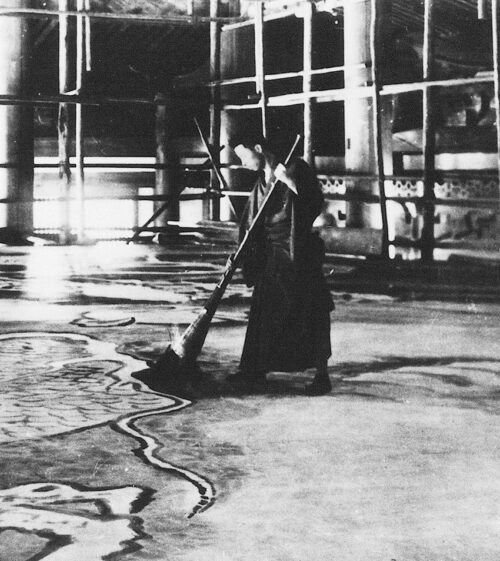
In 1933, he painted “Soryu (Blue Dragon)” on the ceiling of Tofukuji Temple. Unlike the abstract works he would later create at Saihoji, this belonged to the long tradition of unryu-zu (a painting featuring a dragonand clouds). There is something reassuring about that. At the time, he was only beginning to work on fusuma paintings, so he first followed the example of earlier masters, studying subjects that had been handed down through generations. The ceiling was enormous, and it is said that he painted it with a brush as large as a broom.
Following his travels in Europe, Insho’s murals for Chishakuin Temple in Kyoto, dedicated in 1958, reveal the vibrant and distinctly modern style that came to define his work. In the years that followed, many modern nihonga painters began creating fusuma paintings for temples across Japan. Increasingly, these commissions came to serve not only religious purposes but also as venues for artistic expression. Insho was one of the pioneers who helped shape this new direction.
In 1965, at the age of 74, he created fusuma paintings for the guest hall of Saihoji. Four years later, he dedicated a total of 104 fusuma paintings to the temple’s main hall.
Fusuma Paintings: Art in Motion
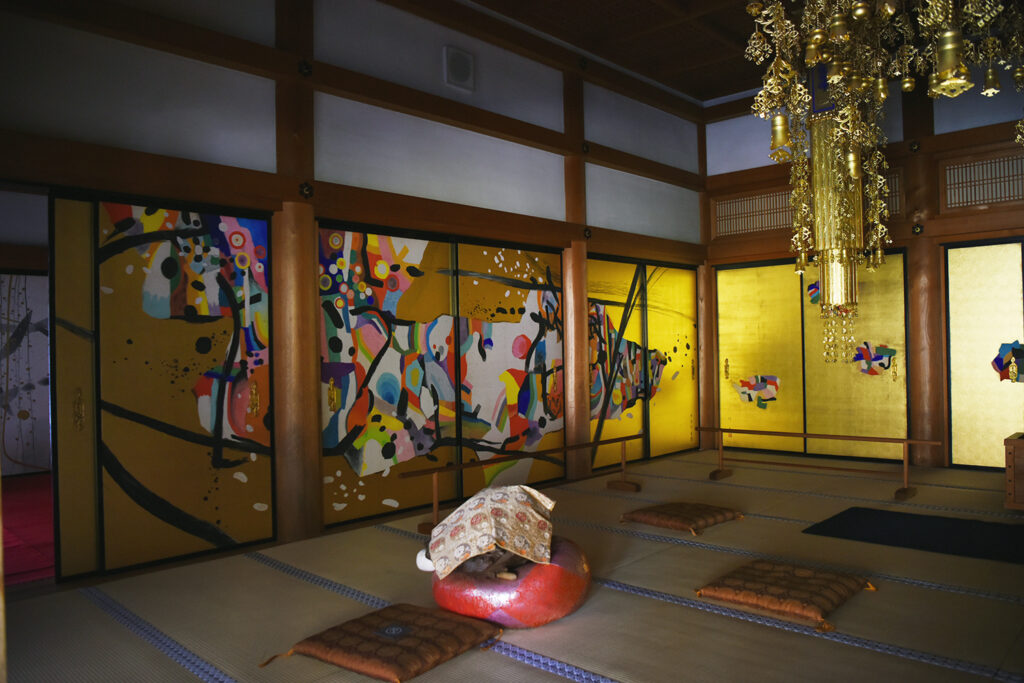
When viewing the fusuma paintings at Saihoji, the first thing to keep in mind is that fusuma paintings were originally meant to move.
Many fusuma paintings from the Muromachi period (1336-1573) survive today, yet we often encounter them through photographs in catalogs or museum displays, leading us to view them as single, self-contained images.
Originally created as part of an architectural space, these works change as you move, and the fusuma themselves shift as they are opened and closed. When viewed from a single fixed perspective, as in a photograph or exhibition display, much of their true appeal is lost. For this reason, when viewing the fusuma paintings in the main hall of Saihojil, it is important to move around and experience them from different angles.
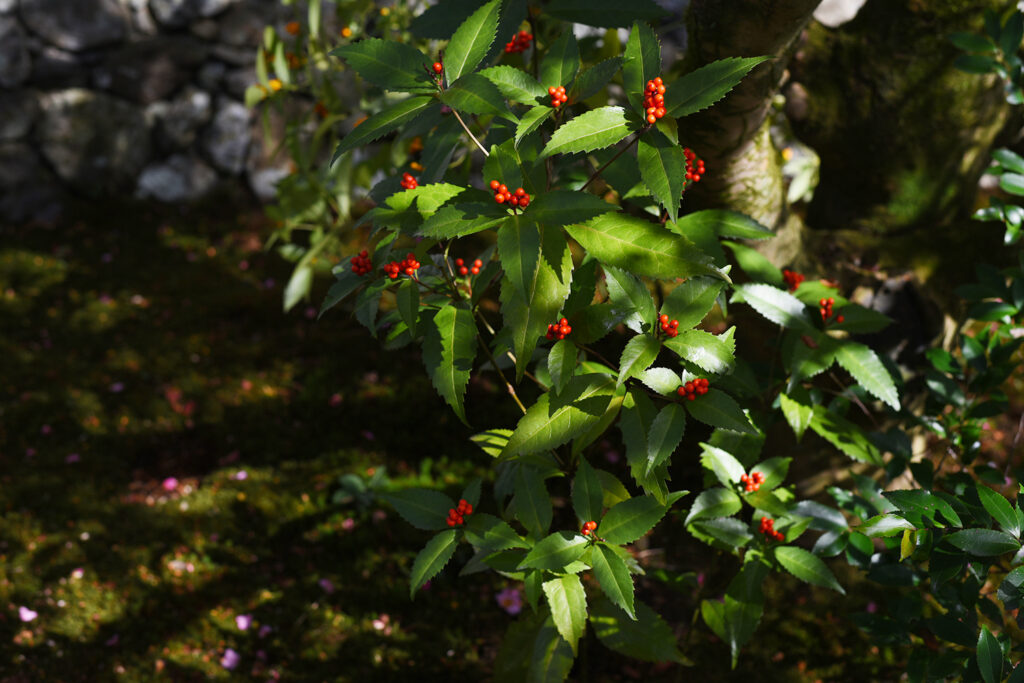
Light is also crucial. Wall and screen paintings initially relied on natural daylight. Museums, however, use constant artificial lighting, freezing the illumination—and the perspective—into a static view.
The impression of fusuma paintings changes completely in natural versus fluorescent light.
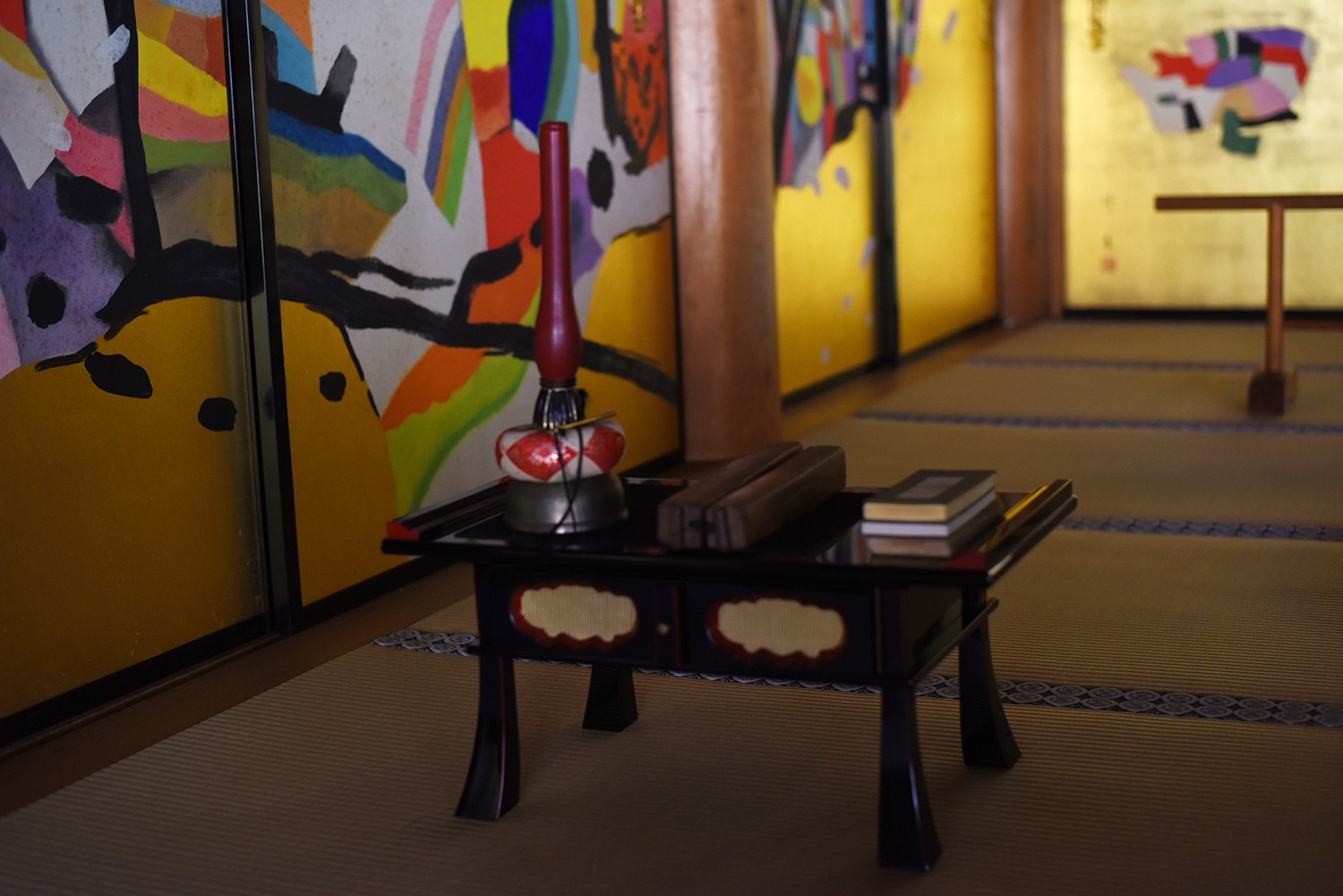
The fusuma paintings at Saihoji feature full gold leaf, black ink with gold accents, and partial coloring. Despite simple compositions, shifting light drastically alters their appearance, especially given gold’s reflectivity. Yet even in ink wash paintings without gold backgrounds, the deep black ink emerging from shadows is exquisitely beautiful.
As daylight shifts, for example, a fusuma painting at 2:30 PM reveals an expression unique to that exact moment. Wall and screen paintings were meant for such dynamic viewing experiences.
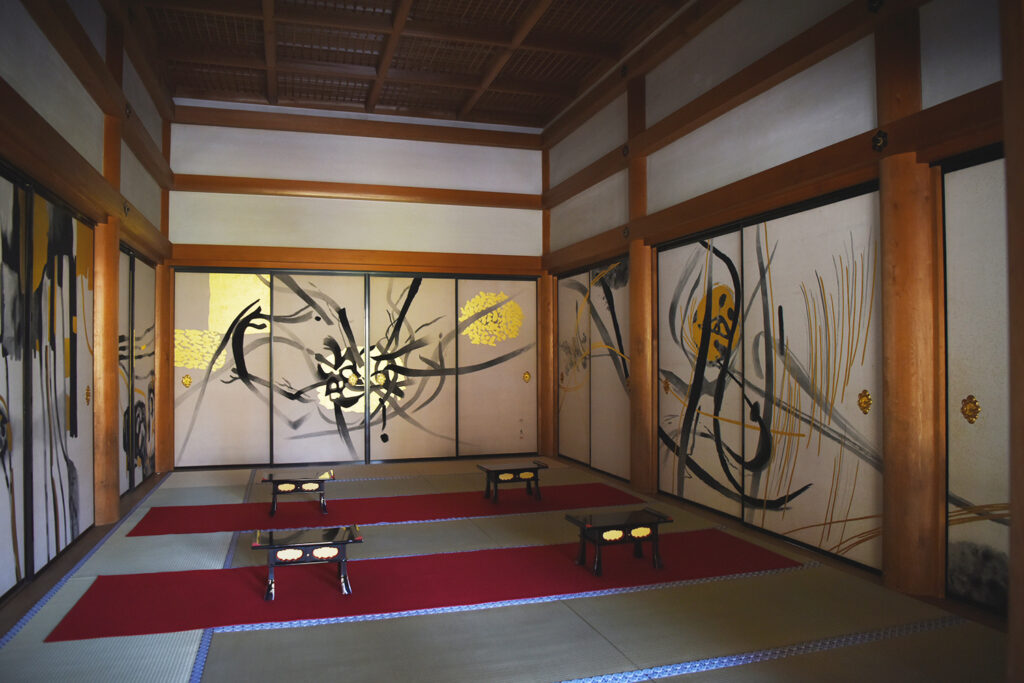
Saihoji’s fusuma paintings also feature dynamic brushwork.
While geometric patterns are meticulously colored from sketches, these fusuma paintings differ, feeling more like calligraphy than painting. As noted earlier, though they are movable, the artwork exudes a profound physicality.
Abstract, yet not entirely.
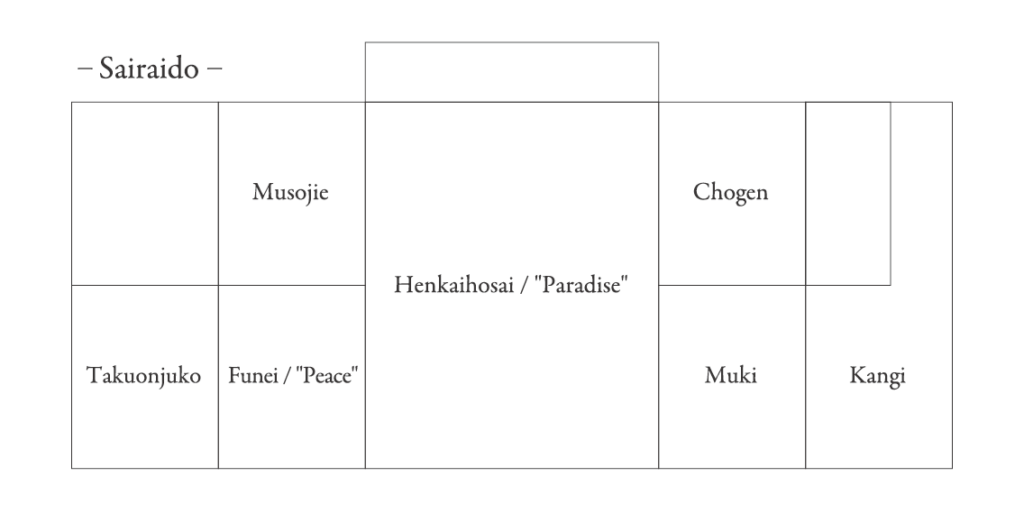
The main hall comprises seven rooms, each bearing a highly esoteric name.
The central Henkaihosai no Ma features gold-leaf fusuma paintings, while other rooms showcase ink wash painting. The artwork perfectly reflects each name. Since Insho often gave his abstract pieces esoteric titles, he likely named these rooms himself.
Did he name the rooms before conceptualizing the art, or after its completion? We may never know. However, these works were clearly not created on a whim. Strolling through, you sense they were meticulously crafted with the layout, lighting, and specific nature of the space in mind.
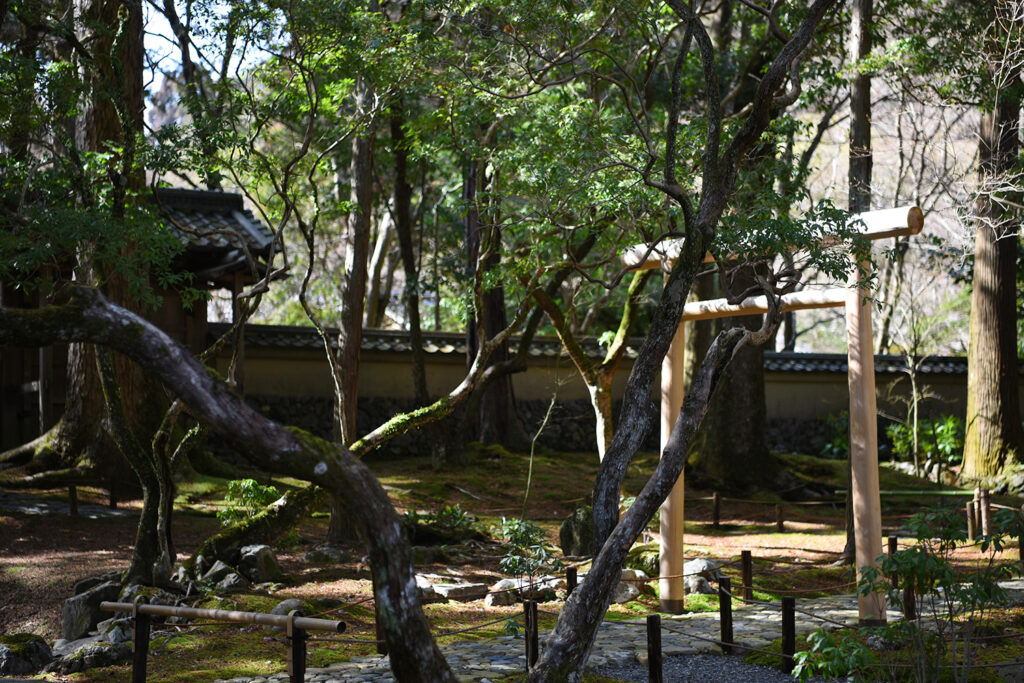
Fusuma paintings at Saihoji are purely abstract. The artist conveys Zen by deconstructing figurative forms into pure abstraction.
Yet, motifs evoking the Japanese plum and sacred lotus appear throughout. This interplay of abstract and figurative elements is designed to move the viewer—the essence of Insho’s art. Thus, literally identifying a “Japanese plum” misses the point.
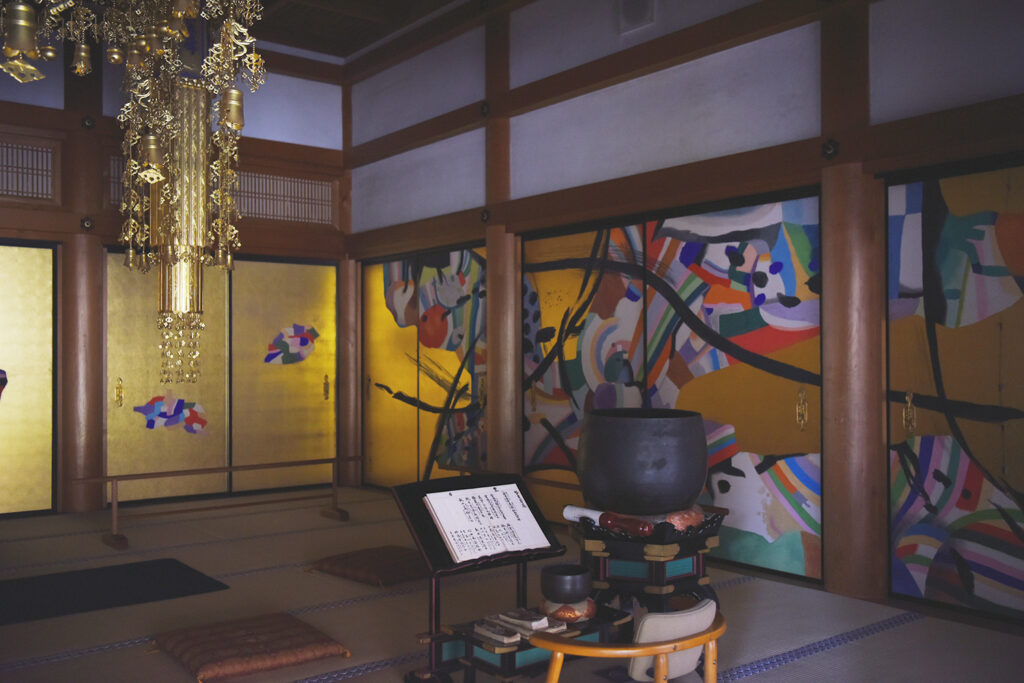
Navigating the profound shifts of the Meiji period, Taisho period, and pre- and both the prewar and postwar Showa periods, Insho explored diverse subjects until his death at 84 in 1975. These fusuma paintings at Saihoji represent his artistic pinnacle. This context offers a fresh perspective.
*Note: The guest hall is normally closed to the public, and only some of the fusuma paintings in the main hall are available for viewing during regular opening periods.
Edited by: MIYAUCHI Toshiki
Written by: HOSOTANI Kana
Photographed by: MOCHIZUKI Sayaka
Image courtesy: the Kyoto Prefectural Insho-Domoto Museum of Fine Arts
*These photos were with permission.
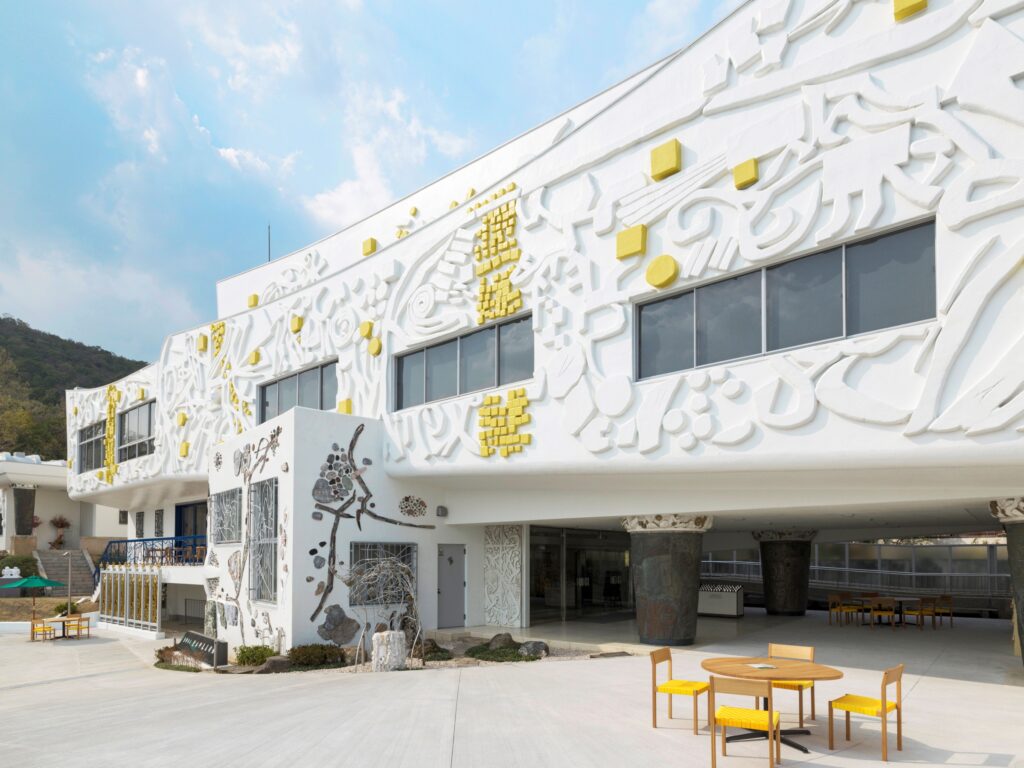
Kyoto Prefectural Insho-Domoto Museum of Fine Arts
Founded in 1966 by Domoto Insho, the museum features an interior and exterior entirely designed by the artist. Its architecture reflects a unique aesthetic inspired by Western palaces and contemporary art museums. In 2025, it was registered as a national Tangible Cultural Property.
https://insho-domoto.com/en/
Up next
Most read