
2026.6.28
People Preserving Saihoji for Future Generations “Wildlife Damage Preventions”
Protecting Mountains and Garden
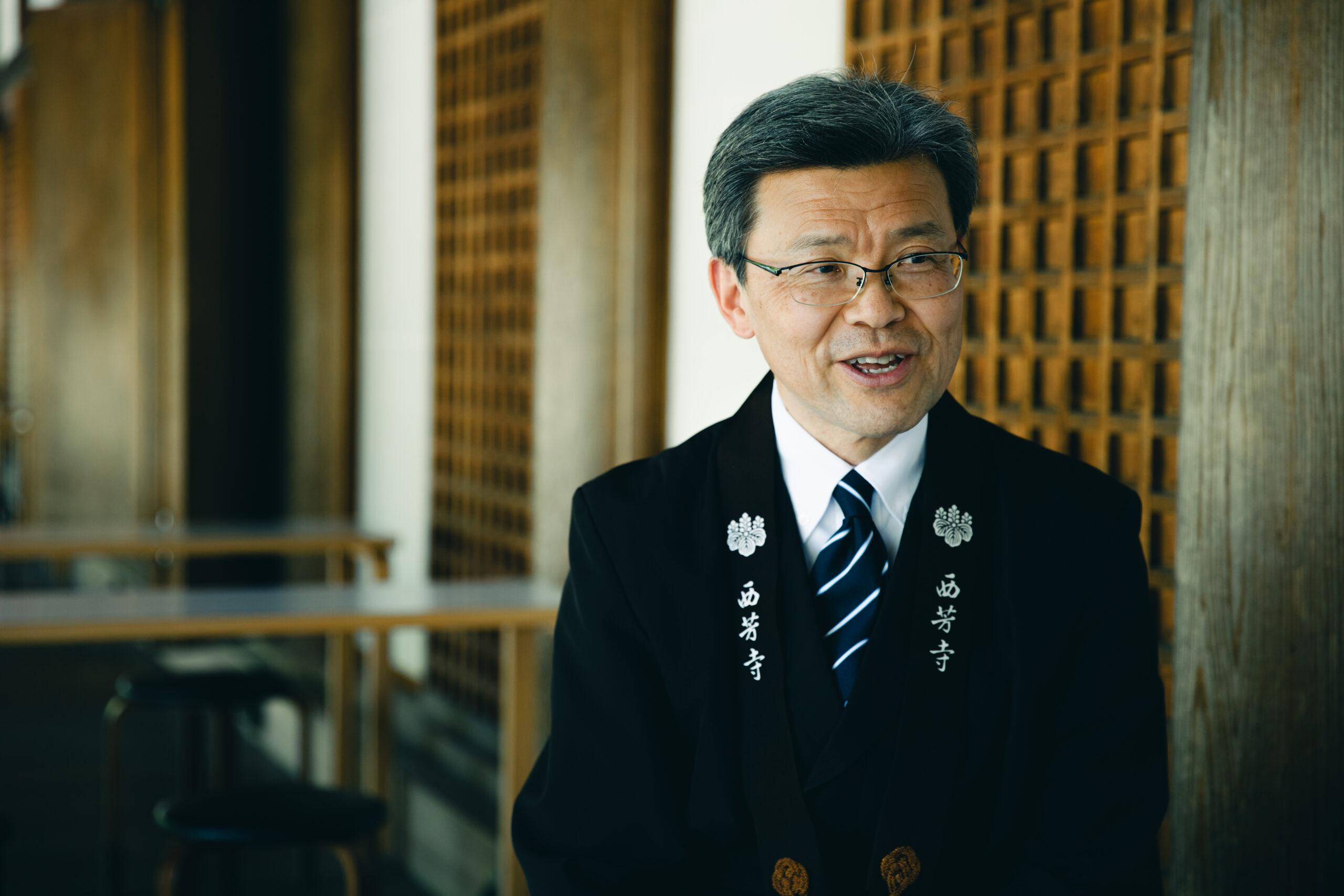
Saihoji Temple is known worldwide for its “Moss Garden.” In order to welcome visitors each day, many people support the temple and its garden with their expert work. In this series, we spotlight the work of those involved in Saihoji, and we will explore what it means to support culture and connect to history.
At Saihoji, damage caused by deer and wild boars has become increasingly serious in recent years. To address this issue, we installed new protective fencing with the assistance of Professor Takayanagi Atsushi, former Associate Professor at the Graduate School of Agriculture, Kyoto University, who has devoted many years to wildlife damage prevention. In this interview, Professor Takayanagi shares the significance of protective fencing and his observations from working at Saihoji.
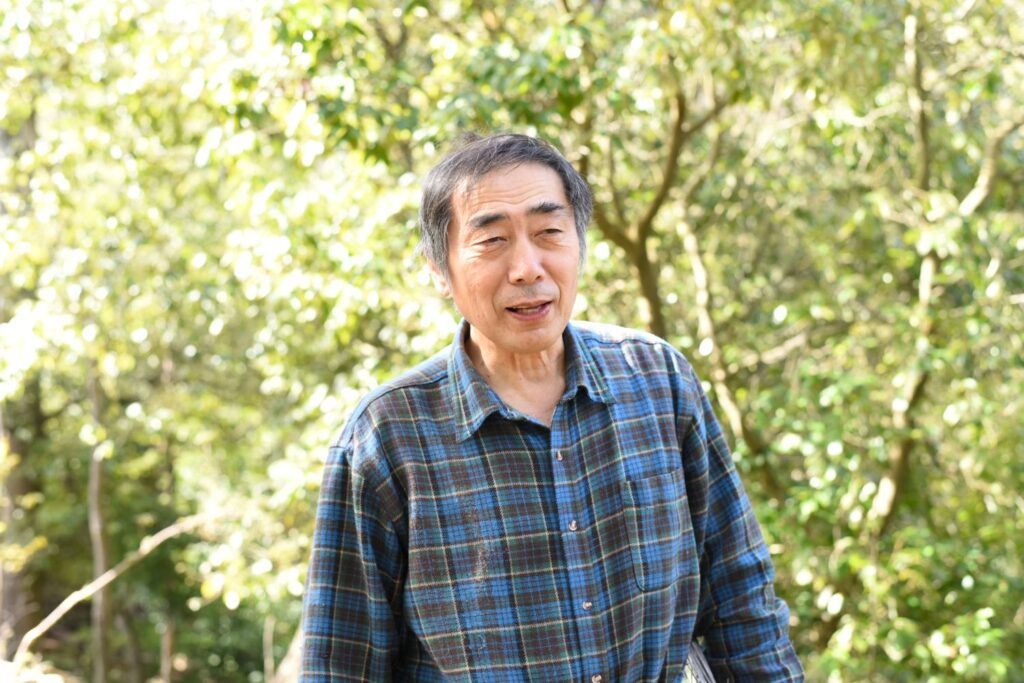
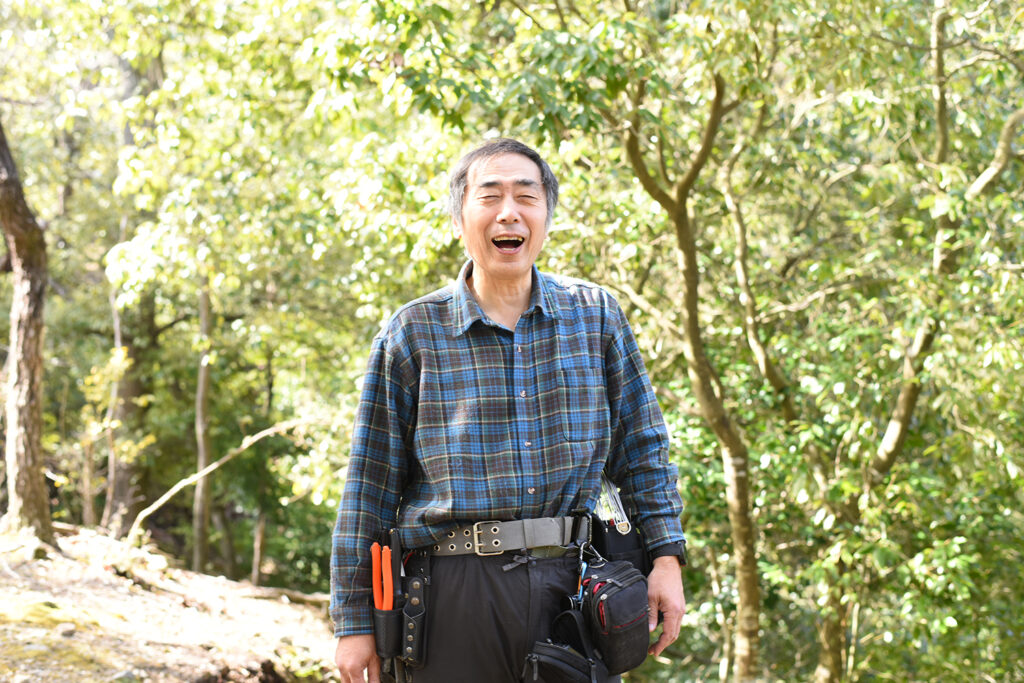
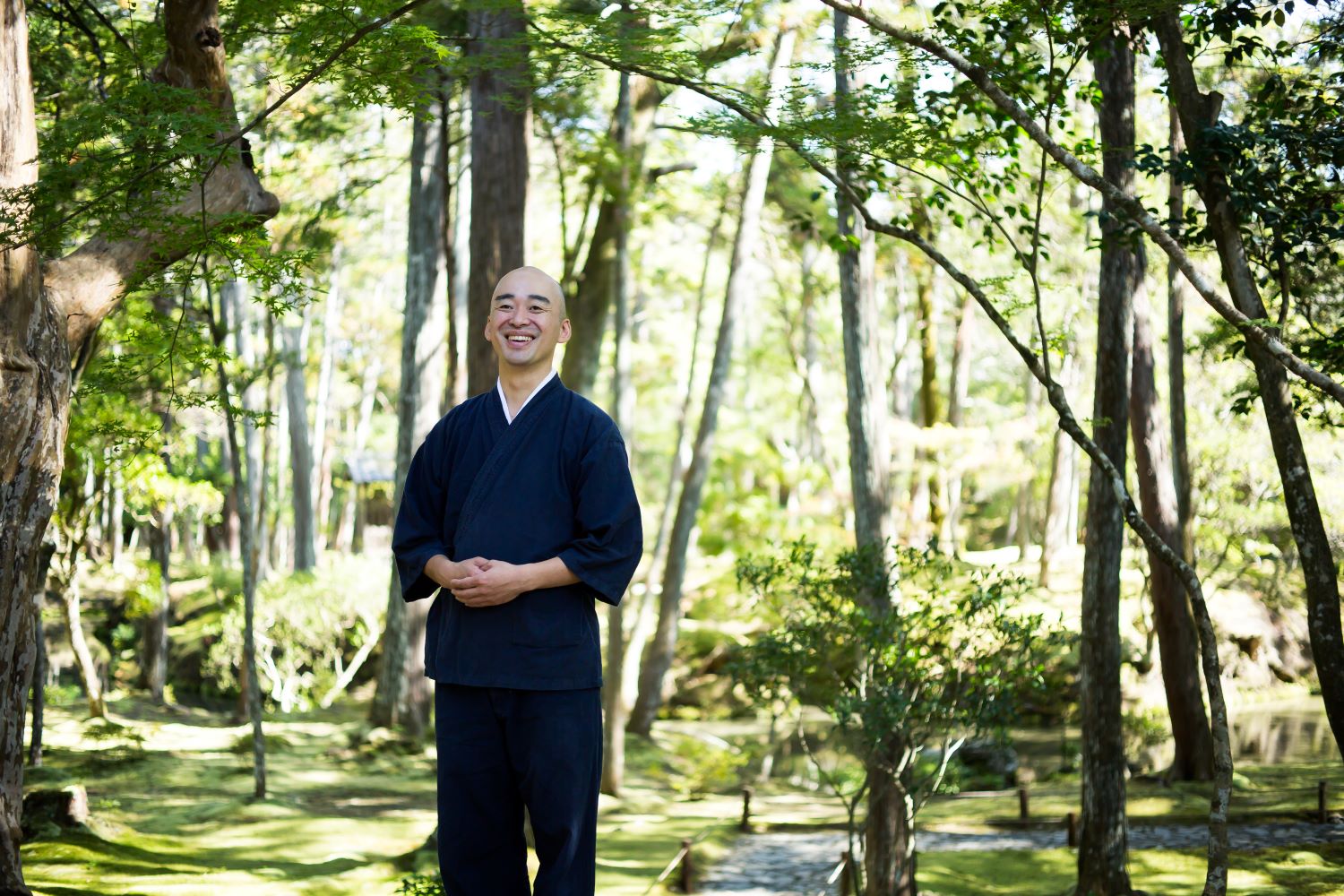
Takayanagi Atsushi
Born in Kanagawa Prefecture. Former Associate Professor at the Graduate School of Agriculture, Kyoto University. His expertise is in wildlife conservation. Representative of the browsing damage prevention volunteer group, Kamoshika-no-kai Kansai. Since the 1980s, he has researched the issue of damage caused by large wildlife and ideal approaches to conservation management, striving to promote appropriate prevention methods through wildlife population surveys and the development of protective fences.
40 years of trial and error with protective fences
ー How did you get involved in installing protective fences?
It began during my university years when damage became a serious national issue. As a Special Natural Monument, they cannot be captured despite the damage. Fencing wasn’t considered then, so the problem remained unaddressed for over a decade after it began in the 1960s.
I always loved animals and wanted to research them. In graduate school, I chose Japanese serow browsing damage in forestry as my theme, determining to find a solution.
ー So, there were no protective fences when you started?
At first, we netted saplings as a countermeasure. However, it was necessary to repeatedly put nets over each individual tree and remove them during the growing season, which required a great deal of time and effort.
In 1982, the government launched a project to install protective fences, and I became involved in the effort. Back then, the general reaction was, “Who would ever put fences up in the mountains?”
Because we initially lacked expertise, we improved the fence by researching its structure and installation methods as we went. I have continued this work for nearly 40 years.
ー How did you become involved with Saihoji?
I was first consulted in 2021There was no damage to the garden or any signs of deer at the time, so I did not consider immediate action necessary.
By 2024, however, browsing damage spread to cherry trees, shrubs, and even hedges. Recognizing the severity, we first reinforced the existing fence near the mountain base. This reduced the damage but failed to prevent it entirely, so we installed new protective fences.
The biggest miscalculation at Saihoji
ー What kind of work is required before the fence is installed?
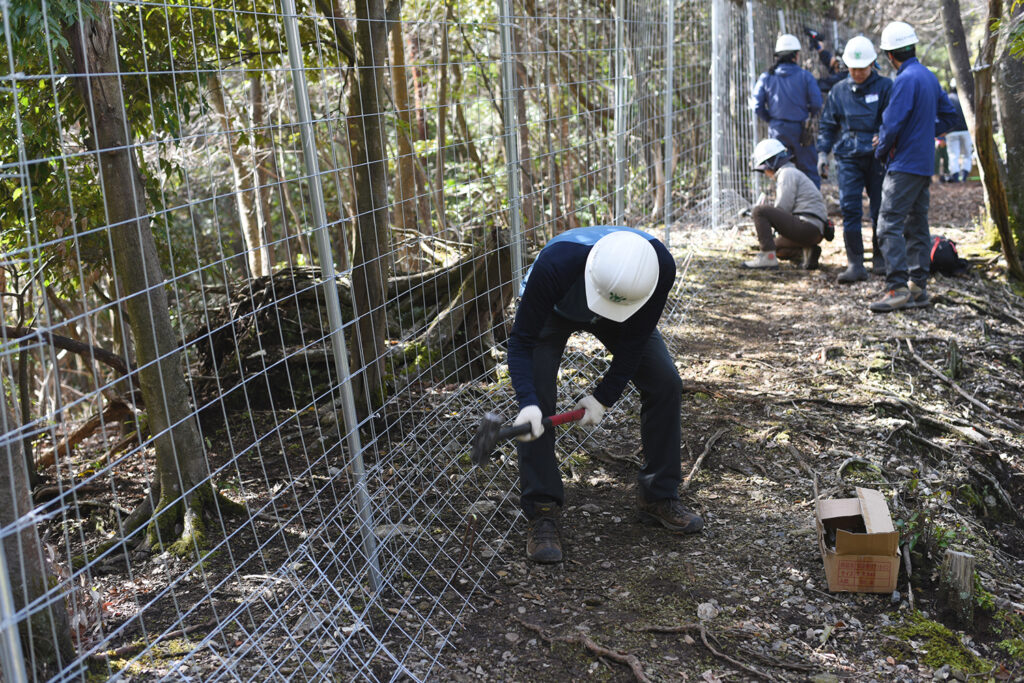
First, we survey the mountain to determine the installation site. A fence installed on a mountain slope is easily damaged by fallen trees, so we decided to install it along the ridge. The total length is approximately 1 km (about 0.62 miles). This is quite long, even among the projects I have handled so far.
Once the installation line is determined, we calculate and procure the necessary materials. Next, we clear trees at the installation site and transport the materials up the mountain.
ー It sounds like a daunting task to transport materials to the summit.
It is incredibly difficult. Because it is impossible to carry them by human power alone, we used a machine called a winch to hoist the heavy materials. However, even with such machinery, hauling the materials up was quite a struggle.
Next, before installing the fence, we laid the foundation. That was where we made our biggest miscalculation.
ー What was the miscalculation?
The ground was much harder than expected. Mountain soil is usually soft, and we assumed the terrain would be fine, but it was incredibly hard.
Upon investigation, we found this area is made of chert, considered the hardest sedimentary rock. Even on a mountain formed of chert, there is usually 50 to 60 cm (about 20 to 23 inches) of topsoil. Yet at Saihoji, there was almost none. This indicates just how depleted the mountain is.
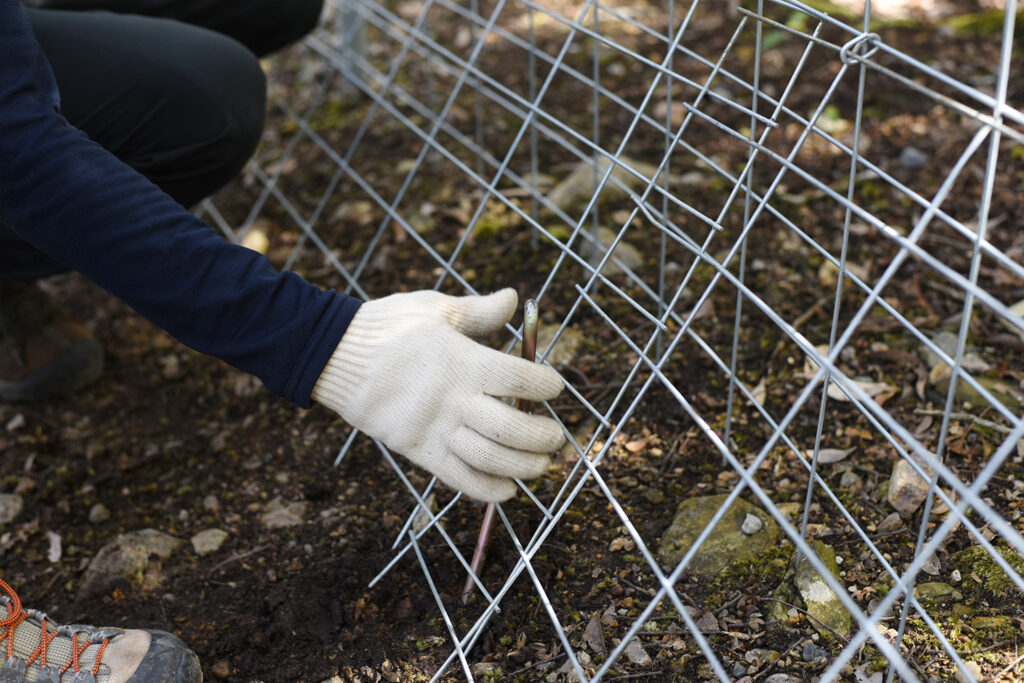
To prevent the fence from falling, the foundation must be firmly driven into the ground. However, the chert is so hard that even a drill cannot pierce it. Therefore, we had to lay the foundation by searching for cracks in the chert, retrying multiple times. It was truly backbreaking work.
The key is to think from a deer’s perspective
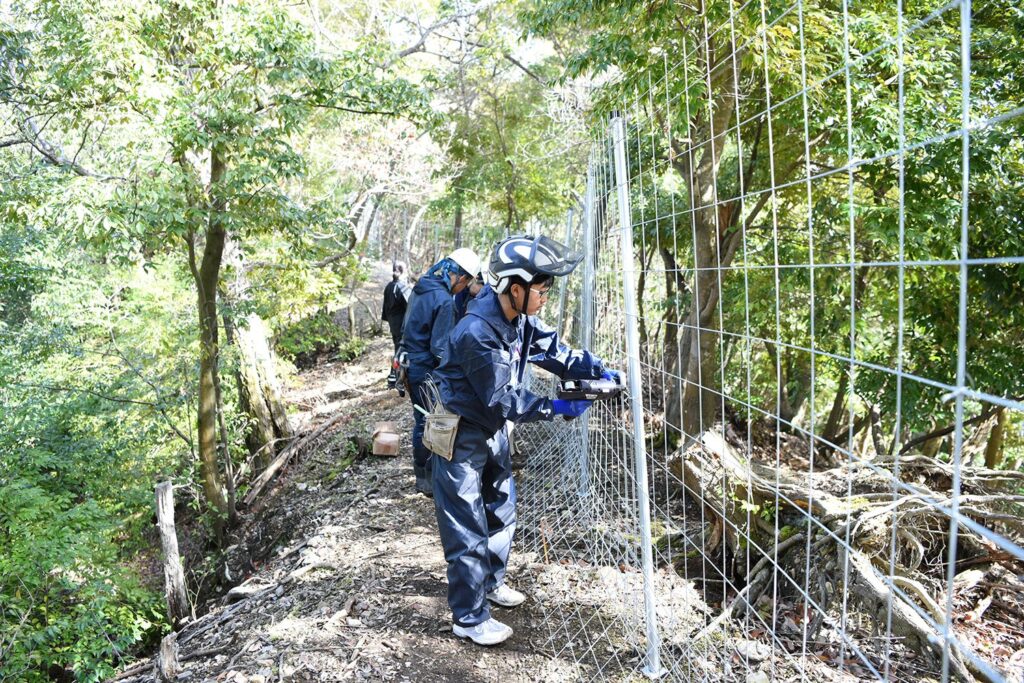
ー On February 23, 2026, volunteers joined the effort, allowing the installation work to move forward significantly. How did things go that day?
We worked alongside 18 volunteers that day. The process went very smoothly thanks to a large turnout of people who have helped us many times before, as well as participants from the practical workshops I regularly teach.
The gardening staff at Saihoji also helped out. Because they are well versed in navigating the mountains, they executed the work precisely. It is thanks to everyone’s efforts that we were able to install a long stretch of fencing all at once.
ー What do you prioritize when installing fences?
You have to think from a deer’s perspective. What would I do if I were trying to breach the fence? It is essential to consider that.
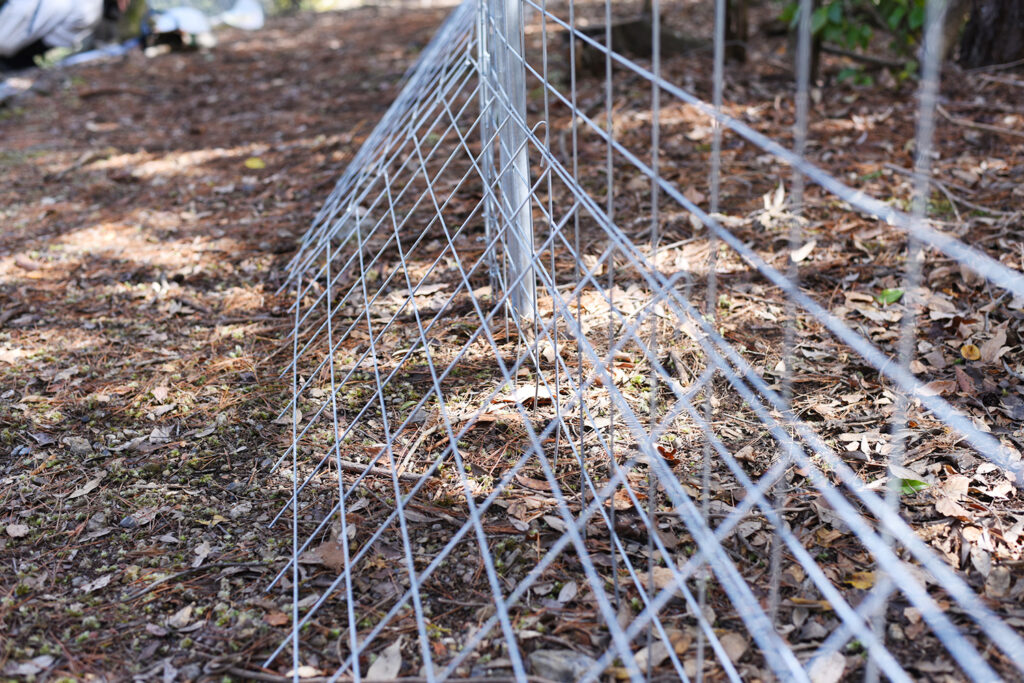
Deer will find gaps along the ground to crawl underneath, climb over if the fence is too low, or sometimes jump in from above. About 80 percent of deer intrusions occur by crawling underneath the fence. Therefore, it is especially important to eliminate any gaps along the ground.
ー How much of a difference do these fences make?
Unless a fallen tree or something similar damages it, the fence is highly unlikely to be breached. Three deer approached during our work but turned back at the fence, proving it is already effective.
Saihoji must be preserved for generations to come, and its grounds are vast. We chose metal fencing to minimize maintenance. With inspections a few times a year, it should last ten years, barring major issues like large fallen trees.
ー Please share your thoughts on the significance of protective fences.
Deer populations are rising recently, yet hunter numbers are falling, making adequate culling increasingly difficult. Mountain-side temples cannot be protected without installing fences. While there are many sites needing protection along Kyoto City’s mountain fringes, fence installation is currently lagging.
One major reason for this is the lack of a subsidy system. Installing fences incurs substantial costs, yet since temples are private properties rather than agricultural or forestry lands, qualifying them for financial support is difficult. Furthermore, the administration’s inadequate grasp of the costs and labor required for installation also hinders the development of an institutional framework.
Another issue is a lack of technicians who can design and install truly effective fences.
ー Do you have any successors?
None at all. People often tell me to take on apprentices, but I am looking for comrades, not apprentices.
I do not install fences to make money. It is driven by my desire to help those in need while coexisting with wildlife. However, since one cannot make a living on that alone, no one steps forward to take on this work.
Conversely, I freely share all information with anyone wishing to learn the techniques. I have not patented the fence specifications I developed. Like seat belts, I believed leaving them unpatented would encourage widespread adoption. Therefore, I believe anyone with the dedication can learn to do this.
It may become a lush forest for the first time in 1,300 years.
ー What is your impression of Saihoji?
I enjoyed the view of the garden from the mountain while working. Looking down, the sight of sunlight streaming into the mossy forest was truly beautiful. I felt a bit privileged, knowing this was a view only I could see.
I recently toured the lower garden for the first time. Knowing that we have protected this garden gave me a deep sense of fulfillment.
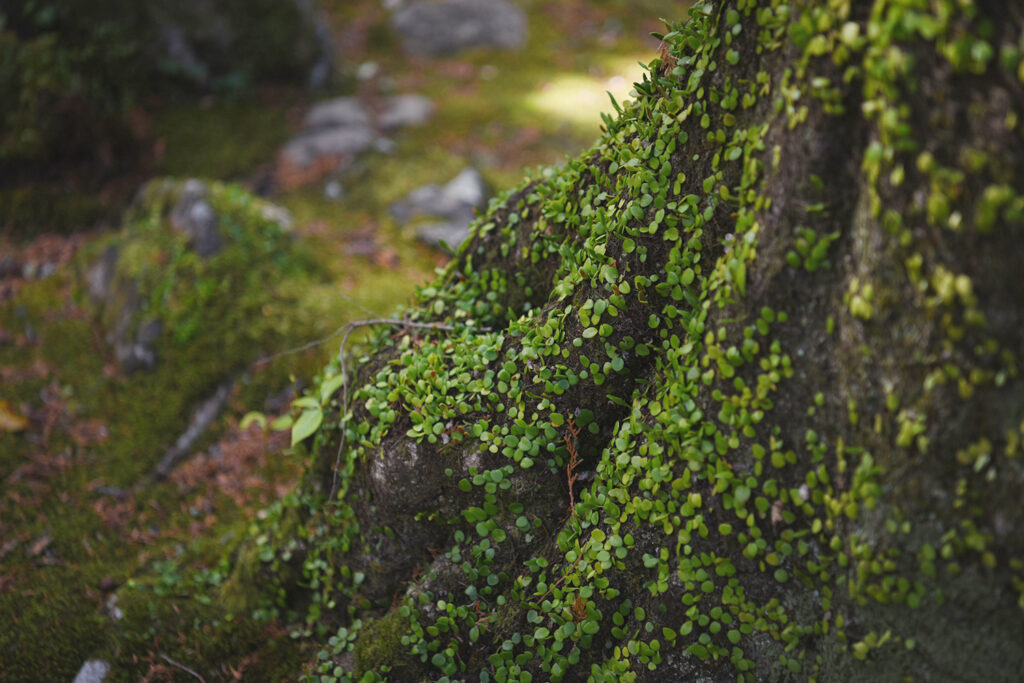
ー What are your thoughts on the mountain around Saihoji?
Partly due to the impact of deer, I found the mountain dark and barren. What surprised me when entering the mountain was that despite its 1,300-year history, there isn’t a single tree that is hundreds of years old. The oldest trees are only about 150 years old at most.
I believe this is due to repeated devastation and logging for firewood and charcoal, which degraded the mountain. I understand there are ancient burial mounds in this area, so I hope the mountain’s environment improves to help protect this site as well.
ー Will the mountain’s environment change once fences keep the sika deer out?
Yes. Without browsing damage from deer, plants will grow. As plants increase, fallen leaves become compost and enrich the soil. Once this cycle emerges, vegetation should eventually recover, though it may take time. The forest on the mountain behind Saihoji may be becoming truly lush for the first time in 1,300 years.
Actually, there is something I must share about this. I realized something after we finished installing the fence.
ー What did you realize?
The newly installed fence completely encloses the catchment area of Saihoji. A catchment area, or watershed, is the region where rainfall flows.
Rain falling on mountains flows downward from the ridges. Since we installed the fence along those ridges, we effectively enclosed the entire water source flowing into the gardens of Saihoji.
As vegetation increases in the catchment area, plants absorb nutrients from rainwater, potentially making the water flowing into the gardens nutrient-poor. In other words, this could affect both water volume and quality.
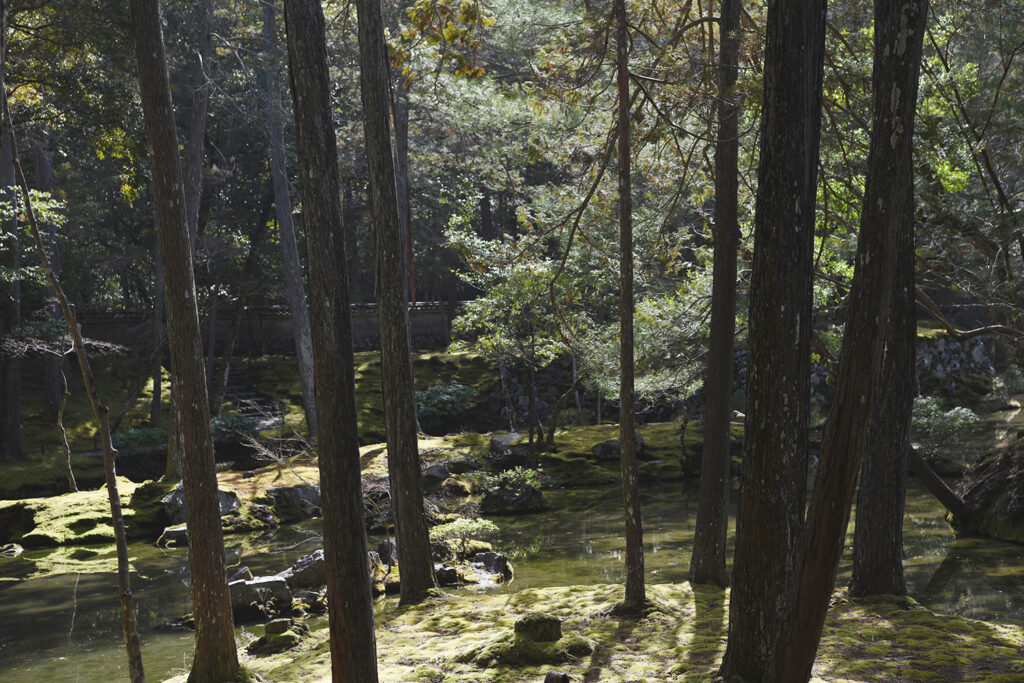
ー So the return of vegetation might not be entirely beneficial.
Exactly. However, Saihoji recently saw changes like increased pond algae and dying sphagnum moss, which may be caused by rising nutrient levels in the water. If so, nutrient-poor water could actually have a positive effect.
Considering this, installing the fence was a highly significant task, doing much more than merely preventing browsing damage by deer.
ー Lastly, what is essential for passing Saihoji on to the next generation?
Saihoji has repeatedly faced ruin and restoration throughout its long history, and it is finally stable today. Moving forward, we must systematically plan how humans will protect this mountain for the next 1,000 years.
Since visitors cannot enter the mountain, it may be hard to imagine, but try considering where the water in this pond comes from, for example. If you view the garden not merely as a cultural property, but as an ecosystem encompassing the mountain, I believe you will discover a completely new perspective.
I hope you will take a greater interest not only in the garden but also in the mountain.
Edited by: MIYAUCHI Toshiki
Written by: HOSOTANI Kana
Photographed by: MOCHIZUKI Sayaka
*These photos were with permission.
Up next
Most read
Your Heart
"What is happiness?"