2026.10.20
Winds of Gold—A Hundred Views of Saihoji Vol. 29
Peter MacMillan / a translator, scholar, poet
In this series of essays on Saihoji the renowned translator of Japanese poetry and poet Peter MacMillan records his impressions of and reflections on his visits to the garden throughout the four seasons. We hope that through these essays you the readers and fans of Saihoji can feel as if you are also present in the magical garden even when you cannot visit us.
Guests in the Garden
When the last visitor leaves Saihoji in the early afternoon and the gate closes, the garden does not fall silent. It simply changes its guests. Monkeys climb over the fences, deer come down from the mountain, and wild boars come to gaze upon the garden in longing to eat its plants. All through the night, the moss belongs to them. Many of the temples of Kyoto stand, like this one, with their backs against the hills, and the boundary between garden and forest has always been indistinct.
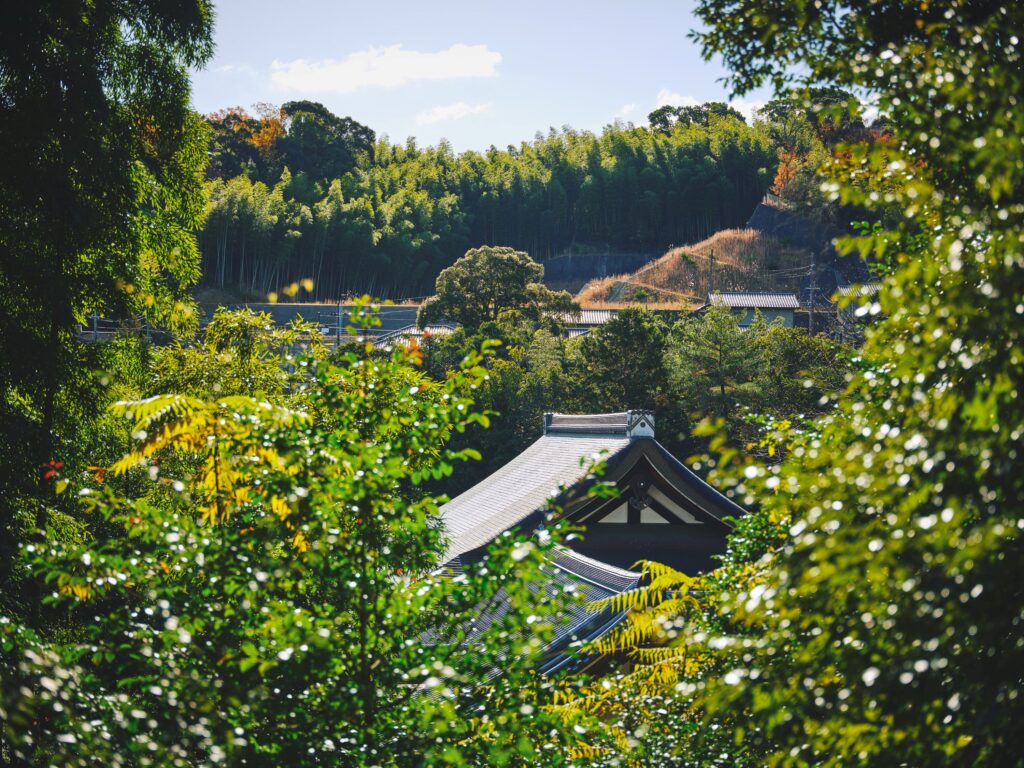
In recent years deer and boar have grown bolder and hungrier, and the damage to the moss has become serious enough that the temple has had to strengthen its fences and think seriously about how to keep the animals out. I understand the necessity, and yet I felt a small pang — the same one, I suspect, the temple staff felt — at the thought of a garden built for the contemplation of nature now defending itself against nature. It reminded me of what I have always felt walking here—that this garden, and my own garden at the foot of Ogura yama, and indeed every place we call ours, is not ours at all. We are borrowing a small corner of the mountain for a while, and the deer, whose ancestors were here long before the garden was first laid out in white sand, might reasonably regard us as the intruders.
People sometimes ask me why I try never to kill anything — not even a mosquito, not even the centipedes that appear in my old house each summer, which I always return to nature. In my garden I have a mushi-zuka, a large rock marking the collective grave that I made for small animals and insects. When we discover a dead insect in the house, we bury it behind the zuka and pray for its repose. Living in Japan, I came to know the Buddhist precept against the taking of life, and the Shinto sense that a kami may dwell in a stone, a tree, an insect. And from my four cats — each with a wholly different personality and set of needs — I have learned that every being is unique. I did not make any of these lives, and I have no right to end them.
The poet Kobayashi Issa, who lost many of his children, wrote many haiku about how we should treasure all living beings. He humanizes the smallest creature by ascribing to it the very human gestures of wringing its hands and its feet.
やれ打つな 蠅が手をすり 足をする
(やれうつな はえがてをすり あしをする)
yare utsu na / hae ga te o suri / ashi o suru
Don’t swat the fly!
It wrings its hands,
it wrings its feet.
I do not think that building fences at Saihōji is bad. The moss, too, must be protected. But I would like us to build our fences knowing what we are doing — with a kind of apology and thanks in our hearts toward the deer and the other animals.
When you walk the garden, remember that you are a guest here, as I am, as the temple itself is a guest on the mountain, and that the truest form of appreciation is simply to feel quietly how bound up we are with every living thing here, in the hills around it, and beyond.
Peter MacMillan
Peter MacMillan is a prize-winning translator, scholar, poet, and President of The Moon is a Boat Co., Ltd.
His translation, One Hundred Poets, One Poem Each (Hyakunin Isshu), was published in 2008, winning prizes in both Japan and the United States. After that, he completed an English translation of The Tales of Ise (Ise Monogatari), which was published by Penguin in 2016. He has also published a collection of poetry entitled Admiring Fields.
Awards:
Recipient of the Donald Keene Center Special Prize for the Translation of Japanese Literature
Recipient of the 44th Special Cultural Translation Prize from the Japan Society of Translators
Nominated for the PEN Award for Poetry Translation for the English translation of The Tale of Ise (Ise no Monogatari)

- Back
- List of articles
- Next
Up next
Most read

Your Heart
“The Concept of Muda”