

2026.11.15
Zen Words for Everyday Life Vol. 18
“Reidan Jichi”
Reidan jichi (冷暖自知) is a Zen phrase that teaches the value of firsthand experience. Translated literally, it says that you cannot know whether water is cold or warm until you touch it yourself.
Imagine dipping your hand into 18℃ (64°F) water. Would you find it cold, or would you find it warm?
It would probably feel cold in summer and warm in winter. Even with a precise measurement on a thermometer, how we perceive it can change depending on the circumstances.
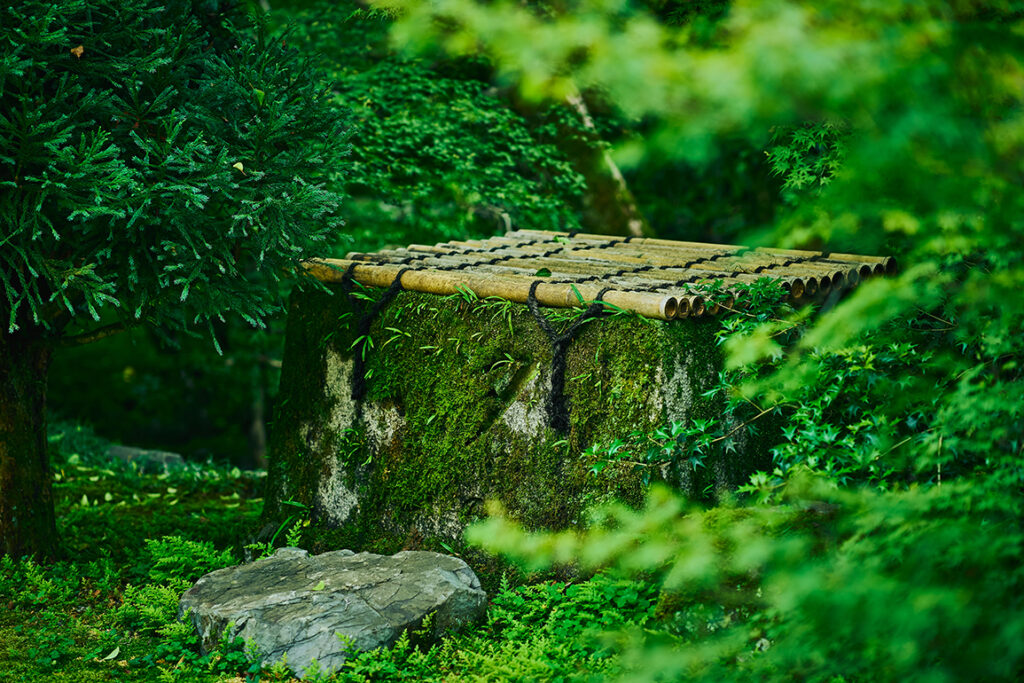
This was something I experienced firsthand during my Zen training. The 18℃ water I mentioned is the temperature of well water, which stays nearly constant throughout the year. Because there was no air conditioning in the training monastery, I came to deeply appreciate the preciousness of this water’s temperature.
These days, there’s an increasing emphasis on time efficiency. Achieving the best results in the least amount of time is seen as the ideal. And with AI, we can now get answers to almost any question or request in a matter of seconds.
But don’t we learn more from failing than from succeeding, and from inconvenience than from convenience? Precisely because we live in an age obsessed with efficiency, perhaps there is a renewed need to experience things for ourselves.
There is a concept called “the benefit of inconvenience,” or fuben-eki. It is advocated by Professor Kawakami Hiroshi of Kyoto University of Advanced Science, who has previously visited Saihoji. It speaks to the value of embracing the inconveniences we would naturally tend to avoid.
Professor Kawakami heads the Further Benefit of a Kind of Inconvenience System Laboratory, a research laboratory in Japan that explores the benefits rather than the drawbacks of inconvenience. The institute suggests defining “convenient” as something that requires no effort or thought. Seen this way, inconvenience is not necessarily an obstacle, but something that can be helpful, or even essential.
The institute’s website offers several examples. If we built an elevator to the summit of Mt. Fuji for the sake of “convenience,” it would completely undermine the point of climbing a mountain. The same logic applies to a bat that hits the ball for you, designed to spare players the “inconvenience” of long practice.
Does this remind you of a time when taking the long way around turned out to be worthwhile?
Of course, we should use AI where it helps, and efficiency certainly has its place. But if we chase nothing but productivity, we risk losing the richness of living.
Whatever we do, there is value in seeing things with our own eyes, listening with our own ears, experiencing things for ourselves, and taking on challenges on our own initiative. Things may not always go as planned, or you might find things tedious along the way. But it is precisely through those firsthand experiences that life just might become fuller and richer.
Saihoji FUJITA Ryuko
Translated by: Aya Katrina Tsunematsu
- Back
- List of articles
- Next
Up next
Most read


Your Heart
"Life and Death"