
2025.12.6
Zen Talks for Your Heart “Busyness”
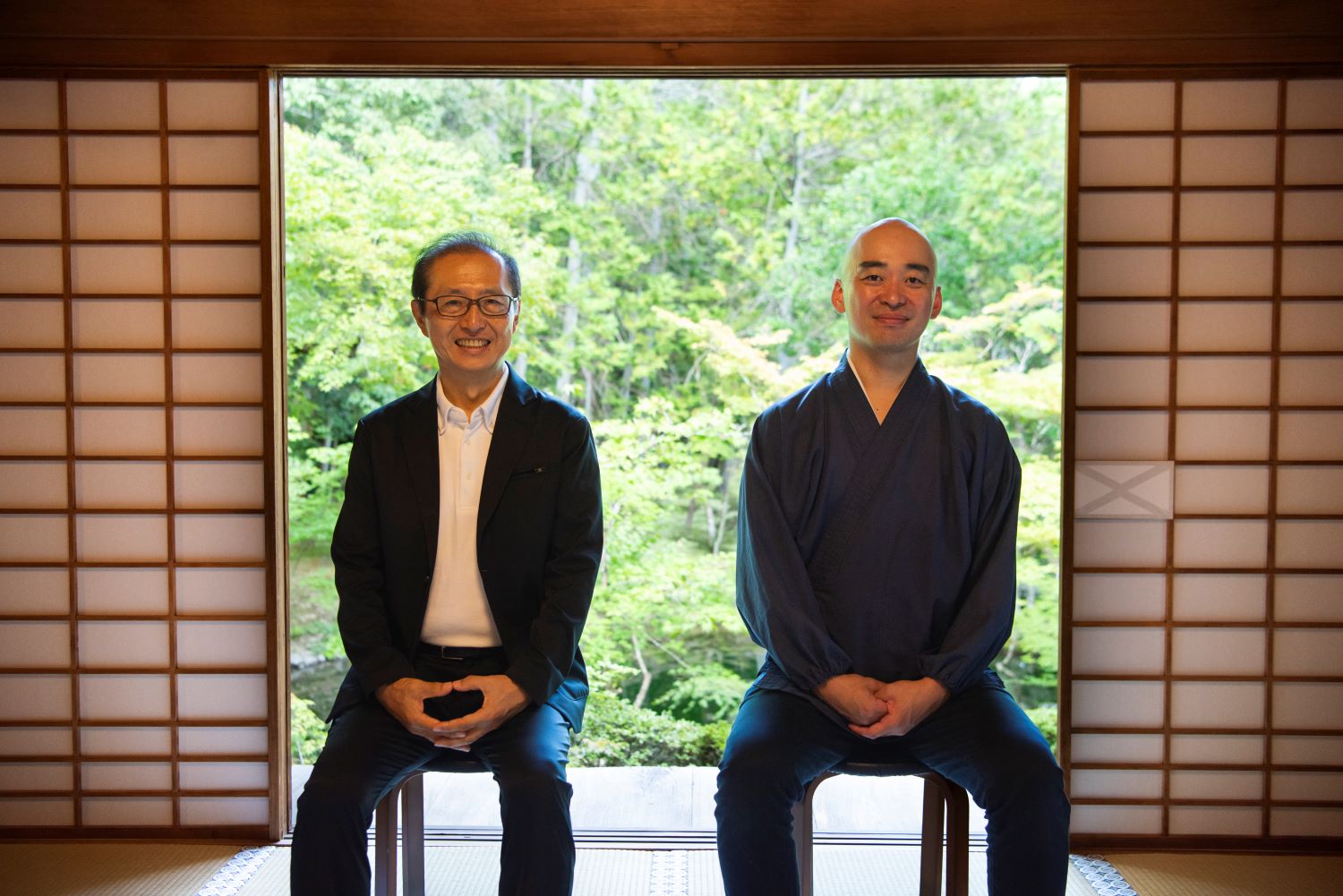
The “Zen Talks for Your Heart” series seeks to reveal the contours of things that are otherwise formless in an attempt to approach their true essence. The theme of this second issue is “what is happiness.” In this issue, we will speak to Ryuko Fujita, a monk of Saihoji, who will share his experiences and thoughts centered on this theme as he reflects on the things he feels from day to day.
In our modern-day society, we are constantly bombarded with information from all sides as we chase the holy grail of ultimate efficiency. We pack our schedules with plans and appointments, leaving not even the tiniest sliver of free, unstructured time, then zip about in a hectic frenzy to get everything done. Such is life for countless people today. How are we to grapple with this state of constant busyness? Is it still possible to live a life of spiritual abundance? Let us take a Buddhist perspective to explore these questions.
The first step is to become aware of your busyness
We live in an age of abundance, where there is always something new emerging to stir our desires. Amid this environment, many people seem to be swallowed up by their busyness. How can we escape this situation? Is there a way? Before we reflect on busyness, Mr. Fujita would like to say something.
“The first sermon that the Buddha gave after attaining enlightenment is called the First Turning of the Wheel of the Dharma. During this sermon, he spoke about the Four Noble Truths. This is something that will apply to all of today's teachings.”
The Four Noble Truths of Buddhism (Shi-tai) are 1) the Truth of Suffering (Ku-tai), 2) the Truth of the Origin of Suffering (Jit-tai), 3) the Truth of the Cessation of Suffering (Met-tai), and 4) the Truth of the Path to the Cessation of Suffering (Dō-tai). In Japanese, these are all written with the kanji 諦 (tai). Although it is usually used to mean “to give up” or “to abandon,” in this case it means “to elucidate” or “to clarify.”
“The First Noble Truth of Ku-tai, for example, elucidates the meaning of suffering (ku). In Buddhism, we say that all things are causes of suffering (issai kaiku). There is, in fact, nothing but suffering in this world, and the point of Ku-tai is to live in full awareness of this truth.
The second truth—Jit-tai—clarifies the fact that humans have desires. Everything in life is suffering, and nothing goes according to plan. Even as we become aware of these facts, however, new desires emerge, such as the desire to become wealthier or to meet someone and fall in love. The first thing we must do is to be aware that these desires are the cause of our suffering.”

It is a rather strict worldview to say that everything in this world is a cause of suffering and the reason for it is our own desire. However, the next truth—Met-tai—gives us some hope.
“Met-tai says that if we can discard our desires and cut ourselves loose from our attachments, then the suffering will cease. It says that the utopia actually exists, and it is to be found in the world of enlightenment, because ‘Nirvana is peace.’
The fourth and final Noble Truth of Dō-tai (the Path to the Cessation of Suffering) seeks to teach us how to attain the state of enlightenment by encouraging us to follow the Noble Eightfold Path (Hasshōdō), which consists of the following righteous practices:
Right View (Shōken): To see things correctly, without prejudice
Right Thought (Shōshiyui): To think correctly
Right Speech (Shōgo): To use words correctly, without lying or speaking ill of others
Right Conduct (Shōgō): To act correctly
Right Livelihood (Shōmyō): To make a living in an ethical way
Right Effort (Shōshōjin): To exert oneself for positive purposes
Right Mindfulness (Shōnen): To observe the world correctly
Right Concentration (Shōjō): To calm the mind and focus on one thing
The Four Noble Truths show us the path toward enlightenment in an incredibly practical, concrete way.”

With the framework of the Four Noble Truths in mind, Mr. Fujita poses the question: What does it actually mean to be busy?
“I believe there are different types of so-called ‘busyness.’ There is the feeling of being busy, but also the appearance of being busy, as observed by others. You can combine these different kinds of busyness from your own perspective and the perspective of others to produce four distinct types. You might not feel busy yourself, but appear to be busy to others. If it doesn’t bother you when they comment on your busyness, then it’s not necessarily a bad state to be in.
On the other hand, if you feel remarkably busy but can’t get anything done, then that is not a good situation, regardless of how you appear to others. You might also have the situation where you feel busy and realize that it cannot go on like this, or you will ruin your health. While it is not good to be in such a situation, it is important to be able to recognize what is happening. Just as the Four Noble Truths elucidate the existence of suffering and desire, Buddhism places great importance on the act of ‘noticing.’”
Throw it all away

There are surely many people who want to reduce the busyness in their lives, but they are flooded with information through their smartphones every single day, making it hard to organize their thoughts. When that’s the world we live in, is it even possible to relieve ourselves of this constant state of busyness?
“You have to start by recognizing that there’s nothing cool about being busy. Even etymologically speaking, the kanji for ‘busy’ 忙 is written by combining the characters for ‘spirit’ 心 and ‘to lose through death’ (亡), so it is by no means something to take pride in.”
Some people may have the notion that to be busy is to be fulfilled, while idleness equates to stagnation.
“Let me share the perfect Zen phrase for busy people,” responds Mr. Fujita. “Hōgejaku. The word hōge is a verb meaning ‘to discard’ or ‘to abandon,’ while jaku adds further emphasis. Taken together it is a powerful command: ‘Throw it away. All of it.’
Imagine that today were your last day on earth. All those things that keep you so busy—you don’t really need them, do you? You only think you need them because you have desires. Perhaps there is some object you want to have, or you want your boss to see you in a positive light, or you want to live more luxuriously. Such desires give rise to the suffering caused by busyness. When you understand this, you will have gone through the first two of the Noble Truths as described by the Buddha: The Truth of Suffering (Ku-tai) and the Truth of the Origin of Suffering (Jit-tai).
That is why I believe that you should give the highest priority to reflecting on the things you are now busying yourself with, and ask yourself whether they are truly important to you. Having done so, you must establish an order of priority and cut out everything that is unnecessary.”

But what if you try to organize yourself and find that everything is important to you? Perhaps you feel that nothing deserves to be eliminated. Prioritizing can be quite painful.
“In that case, picture a box that you must fill with stones of different sizes. If you start by putting in all the small stones, then you won’t be able to fit the big ones. That’s why you should start with the largest stone of all. Consider what is more important to you than anything else—it could be your family, your job, some hobby, or whatever—and put it in the box first. Look at how much space is left, and add the remaining stones in order of their size.
The size of the box will vary from person to person. You might think your box is large, but it might actually be quite small. The overall priority and your personal capacity are things that only you can determine for yourself, so you must take some time to stand still and observe yourself.”
When you’re holding everything in your hands all at once, it can be difficult to decide what to cut out. But if you take the Zen approach of hōgejaku and start off by first dropping everything at once, then you might be able to discover the large stones that had been buried among the small pebbles.
“When the COVID-19 virus spread, we all refrained from doing anything non-essential and non-urgent, but we somehow managed to keep things going. I think a lot of people realized then what was truly important.”
Fully confronting oneself

Busyness has impacts beyond the individual. For example, you might become irritable and snap at those around you. How can you maintain a compassionate and thoughtful heart, even when you are busy? Mr. Fujita would like us to remember the Four Noble Truths.
“One way is to go deeper into a reflection on the Noble Eightfold Path. Ask yourself whether you are practicing the Right View, Right Speech, and Right Concentration. Observe what kind of state you’re in and confirm whether you are putting the Noble Eightfold Path into practice. Doing so might lead you to some realizations.
For example, you might notice how busyness changes you. Do your footsteps become louder? Do you close doors with more force? Busyness manifests itself in different ways for different people. If you learn to recognize how busyness affects you, you become better able to notice when you are in a busy state.”

This allows you to think about countermeasures and makes you aware of the need to be careful. Listening to Mr. Fujita speak, one gets the feeling that a considerable number of people go through life saying they are busy all the time, without ever confronting their own actions or feelings.
“Speaking of confronting oneself, I am reminded of something called the ‘white bear problem.’ That is, the more you try to avoid thinking about something, the more you actually think about it.”
The white bear problem refers to a psychological experiment. Three groups of subjects were shown video of a white bear and given distinct instructions. One group was told to think only of white bears. Another was told they were free to think about white bears or not think about white bears. And the third group was told to refrain from thinking about white bears. This third group that was told to avoid thinking about white bears ended up remembering the most from the content of the video.
“In other words, if there is something that you would rather like to forget, such as an unpleasant comment someone made about you or a certain trauma, then the harder you try to forget it, the more it comes back to you. If that is the case, then the only option is to fully confront the things you don’t want to think about. That is the true Zen approach.”
If someone says something hurtful to you, then you should think about why they would say such a thing to you. If you experience failure at work, then you should reflect on what led you to take the actions you took. You need to dig deeper into the question of “Why?”
“Honestly, confronting yourself is difficult. But as you make the effort to organize your thoughts, there will surely come a moment when the penny drops. I want you to confront your busyness in the same way. If you do, then you will uncover its essence and find a solution.”
Were you born to live a busy life?

“The Buddhist scholar Nakamura Hajime once said, ‘There is nothing wrong with finding fulfillment in busyness.’ However, he also went on to say that ‘No matter how much you keep yourself busy, you will never be able to overcome old age and death. We need to accept that futility.’
So, ask yourself, ‘Were you born to live a busy life?’ Professor Nakamura's words should open our eyes to this fundamental question.”
After saying that there is nothing inherently wrong with busyness, he confronts us with old age and death. His words hit deep, precisely because they touch on the truths from which we usually avert our eyes.
“We spoke about Life and Death in an earlier installment in this series. We discussed how if you want to lead a rich life, then you must not focus your attention solely on the urgent matters right before your eyes. Instead, you should invest time in the things that are not urgent but important. If we take this a step further, we can ask ourselves whether these things really lack urgency. Is it perhaps not the case that we simply think they lack urgency because we assume that we still have a lot of time left on earth?”

“Consider the things you are doing now. Do you really need to do all of them? Probably not. After all, do you even remember everything you did three days ago? You have probably forgotten most of them. This is especially the case for busy people, and when you consider this fact, then we come back to the idea of hōgejaku. I won’t go as far as to command you to abandon everything, but I think you can make more intentional choices about what you will keep and what you will throw away.”
Mr. Fujita’s wish is for people to become aware of these questions and visit the temple or other peaceful places to confront themselves.
“The next time you have a day off, plan a visit to a temple or some other quiet, peaceful place and force yourself to stop and be still for a while. Make it a digital detox day, where you leave your smartphone behind and avoid taking pictures. Let go of all your obligations and desires and carve out some time to confront yourself.”
Interviewed and edited by: MIYAUCHI Toshiki
Written by: HOSOTANI Kana
Photographed by: MOCHIZUKI Sayaka
*These photos were with permission.
PROFILE
Fujita Ryuko was born and raised in Saihoji Temple. After working for Sumitomo Corporation, a large trading company and traveling back and forth between Japan and the U.S, he became aware of his mission to devote his life to preserving Saihoji and disseminating Zen. He practices Zen training and is the vice head of Saihoji.
- Back
- List of articles
- Next
Up next
Most read
Your Heart
“The Concept of Muda”