
2026.3.20
Winds of Gold—A Hundred Views of Saihoji Vol. 23
Peter MacMillan / a translator, scholar, poet
In this series of essays on Saihoji the renowned translator of Japanese poetry and poet Peter MacMillan records his impressions of and reflections on his visits to the garden throughout the four seasons. We hope that through these essays you the readers and fans of Saihoji can feel as if you are also present in the magical garden even when you cannot visit us.
The Torii Within Your Heart
It is a beautiful morning at 8 am when I arrive. The young leaves of the ancient lotus blossoms have just begun to spread in the pond in front of the entrance, a symbol of the re-birth of spring all over the world. Inside the entrance, azaleas are beginning to bloom early and the maple leaves which have just emerged are a beautiful pale yellowish green.
Have you ever noticed that sometimes we can see a torii that usually mark the entrance to a shrine in a temple? The reason for this is that Japan has since ancient times a tradition of religious tolerance that permits the co-existence of Shinto shrines and Buddhist temples even in the same precinct. The shrine was sometimes dedicated to the god that protects the temple, and Shinto gods were sometimes interpreted as manifestations of Buddhas. The syncretic relationship between both religions was very important in the development of Japanese religion. In the Meiji Period the government separated both Shinto and Buddhism and many temples were destroyed. However, Buddhism and Shinto are still an integral part of the everyday lives of the Japanese people.
Today it is my first day to see a new torii gate that has been newly erected in front of the sacred stone of the garden (yogoseki stone). There is a shimenawa rope hanging over it to show its sacred nature. Note that the object of worship is not a god but a rock, as Shinto believes that gods come upon all objects in nature.
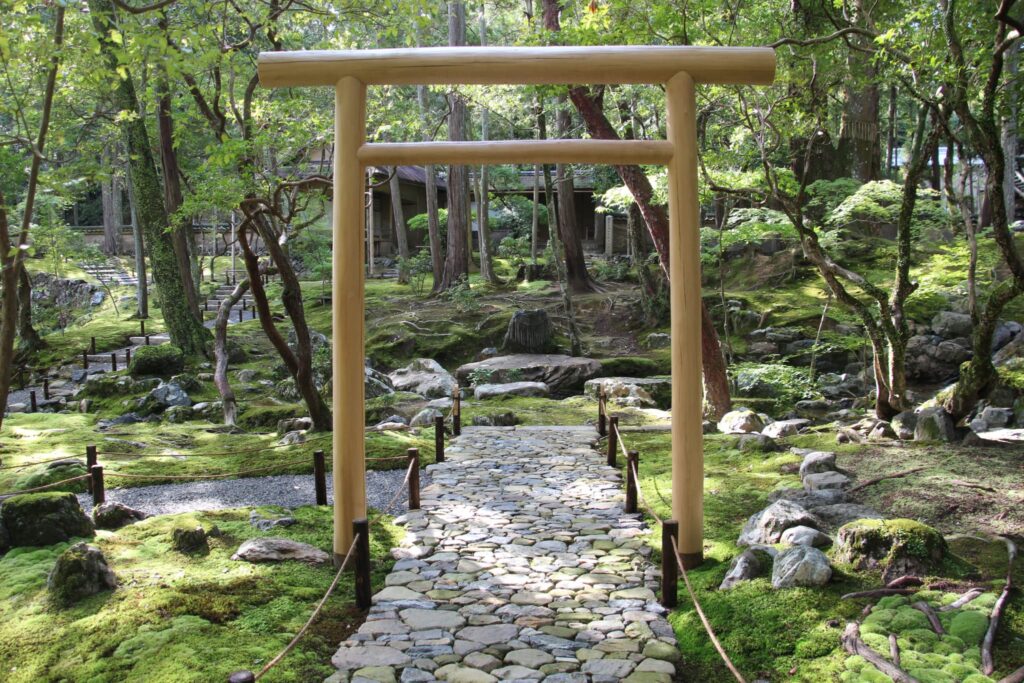
Saihoji almost went to ruin in the 14th century. But the chief priest of Matsuno’o Taisha Shrine, Fujiwara Chikahide, had a dream in which Matsuno’o Myojin, a deity of Matsuo Taisha shirine, ordered him to restore Saihoji, so he called upon Muso Kokushi to rebuild the temple in 1339. The area around the stone with a rope is where the deity appeared in his dream. And this is the sacred stone that visitors can now pray in front of.
The torii will certainly enrich our experience of Saihoji by providing new vistas but also in restoring a syncretic religious element to the garden. Traditionally used at entrances to Shinto shrines, it joins the tiny shrine on Yuhi ga shima as another Shinto feature in the garden.
The idea of religious tolerance embedded in the syncretic nature of Japanese religion is called shinbutsu shugo (Buddhist and Shinto religious syncretism). It is a very potent reminder of the importance of ecumenism and tolerance in our contemporary world which is filled with conflict and religious strife.
Torri gates symbolically mark the transition from the mundane to the sacred, and I would like to end the essay by thinking of sacred spaces in our lives. The traditional view is that when we walk through the torii gate we are entering sacred spaces, but if we think of the Shinto idea that there is a god in each and every thing in nature, —in trees and rocks and birds and animals and insects —then everywhere is a sacred space. If you treasure this kind of image of the torii in your heart, then you will come to realize that everything around you is sacred and the more you relate to each being as a sacred being—even to the tiniest insect— the more you will also become conscious of the nobility and sacredness of your own existence.
Peter MacMillan
Peter MacMillan is a prize-winning translator, scholar, poet, and President of The Moon is a Boat Co., Ltd.
His translation, One Hundred Poets, One Poem Each (Hyakunin Isshu), was published in 2008, winning prizes in both Japan and the United States. After that, he completed an English translation of The Tales of Ise (Ise Monogatari), which was published by Penguin in 2016. He has also published a collection of poetry entitled Admiring Fields.
Awards:
Recipient of the Donald Keene Center Special Prize for the Translation of Japanese Literature
Recipient of the 44th Special Cultural Translation Prize from the Japan Society of Translators
Nominated for the PEN Award for Poetry Translation for the English translation of The Tale of Ise (Ise no Monogatari)

- Back
- List of articles
- Next
Up next
Most read