
2026.1.20
Winds of Gold—A Hundred Views of Saihoji Vol. 21
Peter MacMillan / a translator, scholar, poet
In this series of essays on Saihoji the renowned translator of Japanese poetry and poet Peter MacMillan records his impressions of and reflections on his visits to the garden throughout the four seasons. We hope that through these essays you the readers and fans of Saihoji can feel as if you are also present in the magical garden even when you cannot visit us.
Rock, Rain, Path, Pond, Moss, Sky, ….
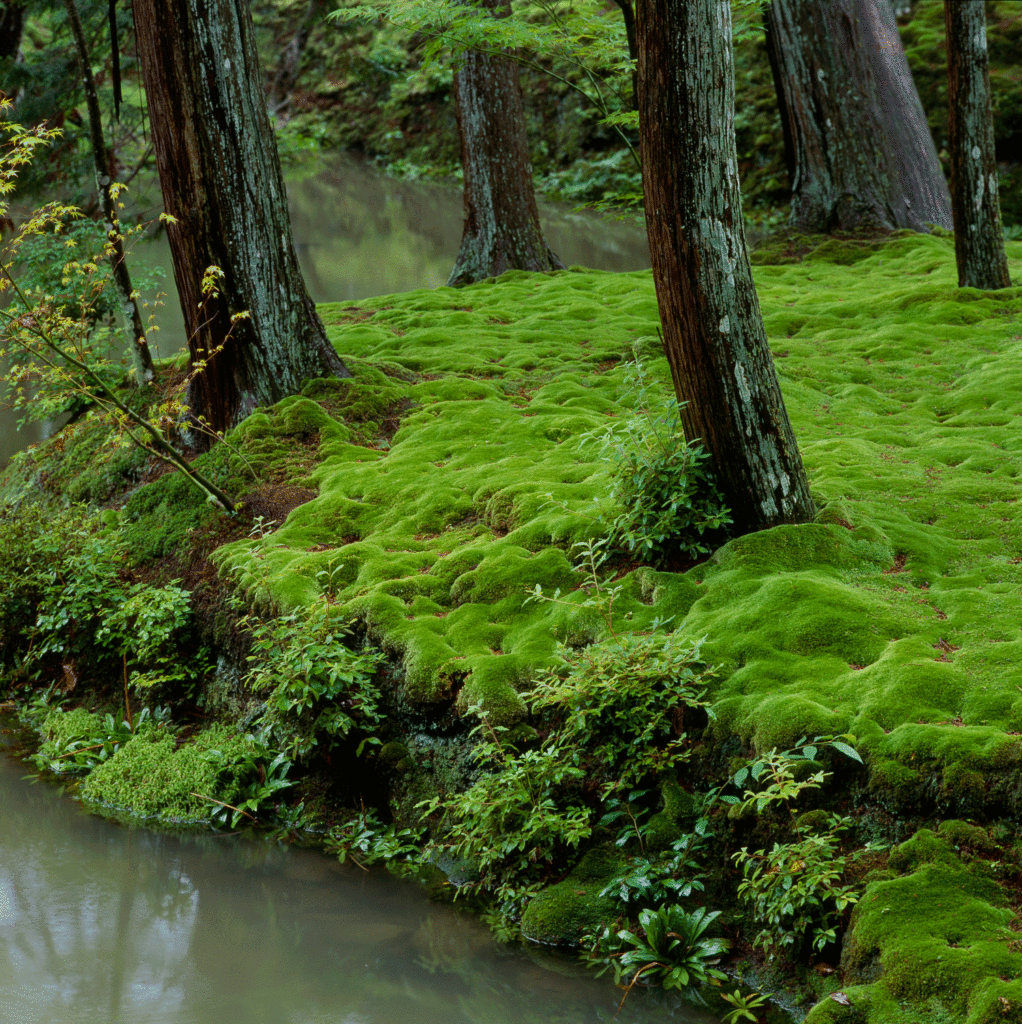
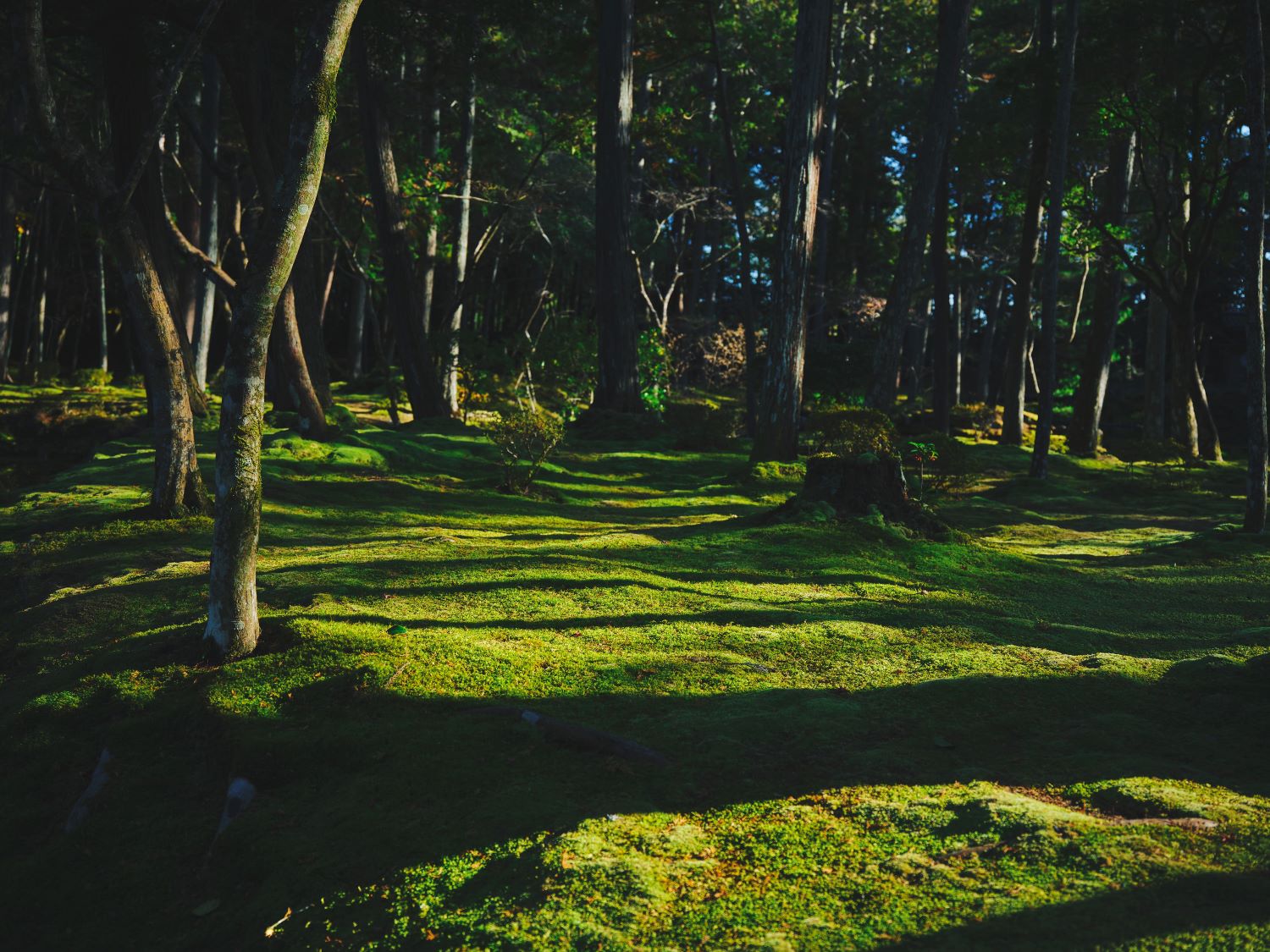
This morning the garden is very peaceful in a gently falling rain under a grey sky in the middle of January. There is less leaf coverage, and the main hall is more clearly visible from the garden. The sounds are so clear that I can hear my own feet walking along the glistening stone path, and cries of the brown-eared bulbul are sharp and piercing. In this grey world, it seems as if the garden has been reduced to its essential elements, rock, rain, path, pond, moss, sky.
From mid-January to February, the Nichi-nichi sanpai is closed to allow the moss to rest and for the garden to undergo maintenance work. During that time visitors can instead visit the temple’s main hall and see its many magnificent sliding screens painted by Domoto Insho.
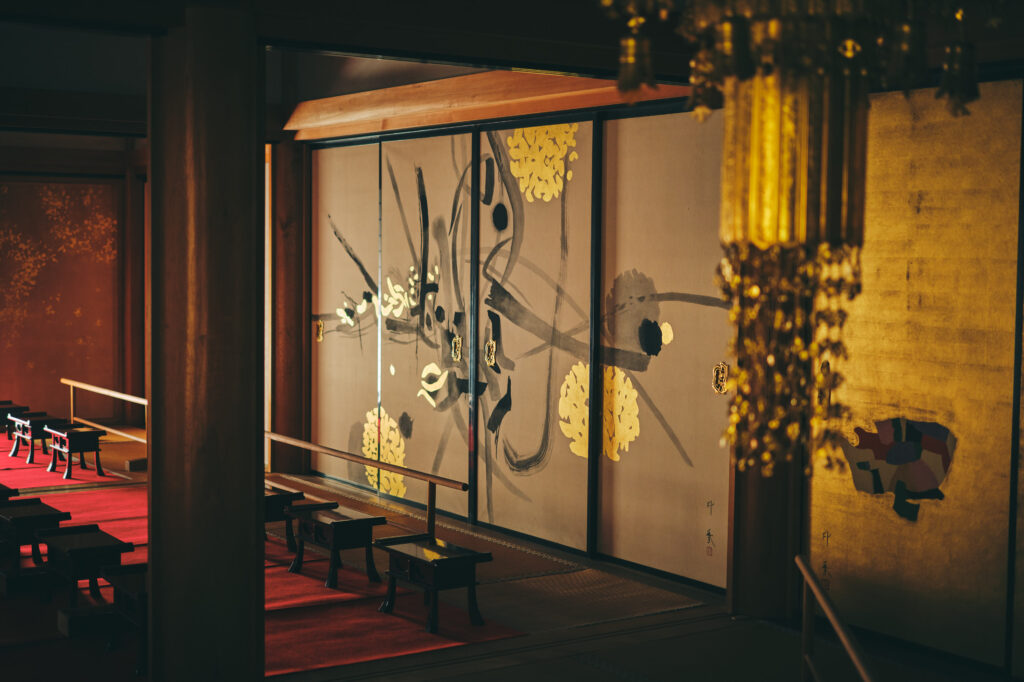
Domoto Insho was an artist active in the Kyoto art world during the Taisho and Showa periods. Up to World War II, Domoto had established himself firmly in the tradition of Japanese paintings with his images of flower-and-bird landscapes and Buddhist paintings, but after the war various artistic influences such as the Art Informel, and his deep faith in Buddhism gradually led to profound changes in his style. He believed that the true traditional artist had to break away from tradition to create a new art form. In Domoto’s case the shift was to abstract painting. Screens up to that time generally depicted traditional scenes such as birds and flowers, a genre originally inherited from Chinese painting, so Domoto’s abtract sliding screen paintings were quite revolutionary at the time.
The 104 screen paintings at Saihoji which Domoto painted from 1969 to 1970 were also part of this revolutionary phase of his artistic life, and it is Fthought that the sliding door paintings were gradually installed after the main hall was completed in May 1969.
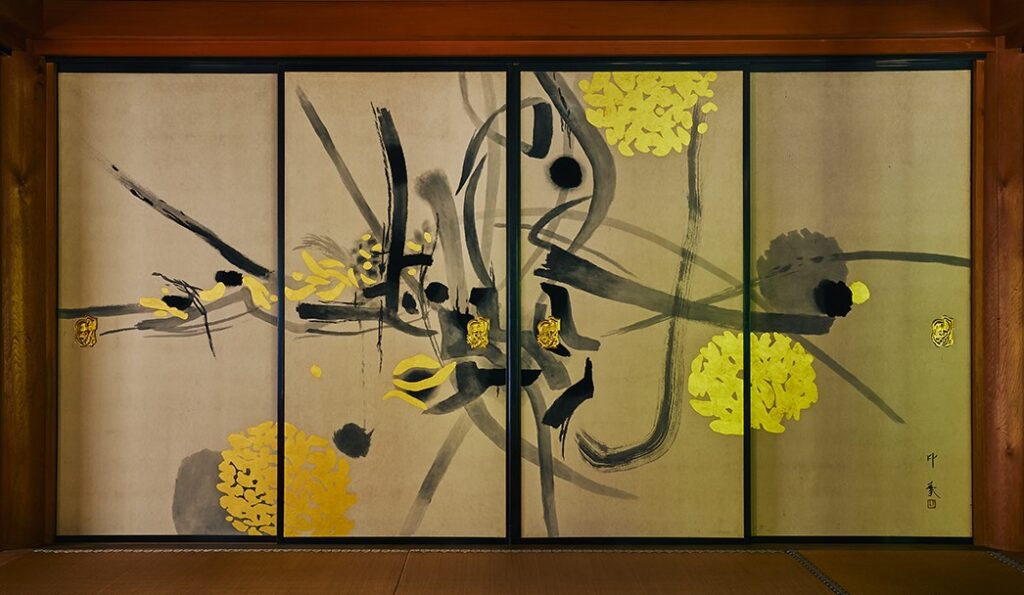
In these works, Domoto developed his own themes based on Buddhist concepts. The idea of employing abstraction to express Buddhist belief was a first and must have confused many of his admirers at the time. But looking at them now, they seem fresh and original, a perfect melding of Western abstraction with Japanese techniques. The empty spaces—yohaku— and brush strokes are reminiscent of Japanese calligraphy, while the rich coloring is suggestive of Western abstraction. As Yamada Yukiyo, a former curator at the Domoto Museum has written, Domoto skillfully utilizes materials unique to Japanese painting, such as pigment tones, gold and silver leaf, mineral pigments, ink color variation etc. His works are deeply reminiscent of the Western tradition, but at the same time quintessentially Japanese. The screen paintings at Saihoji Temple express a high pinnacle of Domoto’s development as an abstract painter.
One meaning of abstraction is the elimination of all peripheral elements around us to create a world where all things are reduced to the essential. Looking at Domoto’s works this morning, I can find the same world reduced to essential elements that I saw outside this morning—rock, rain, path, pond, moss, and sky. But Domoto has also added depictions of a rich and splendid universe filled with all things and, above all, the presence of the Buddha. So, to describe his screens, I end with a new list: rock, rain, path, pond, moss, sky, a whole universe imbued with the golden light of the Buddha!
And a question: How would you depict the Saihoji garden as a manifestation of Buddhist thought? Answer: It can be in a painting, too, but it can also be in the way you choose to live your life.
Peter MacMillan
Peter MacMillan is a prize-winning translator, scholar, poet, and President of The Moon is a Boat Co., Ltd.
His translation, One Hundred Poets, One Poem Each (Hyakunin Isshu), was published in 2008, winning prizes in both Japan and the United States. After that, he completed an English translation of The Tales of Ise (Ise Monogatari), which was published by Penguin in 2016. He has also published a collection of poetry entitled Admiring Fields.
Awards:
Recipient of the Donald Keene Center Special Prize for the Translation of Japanese Literature
Recipient of the 44th Special Cultural Translation Prize from the Japan Society of Translators
Nominated for the PEN Award for Poetry Translation for the English translation of The Tale of Ise (Ise no Monogatari)
Up next

Most read
Your Heart
“The Concept of Muda”